AI in Access Management: What’s Actually Working in Practice Today



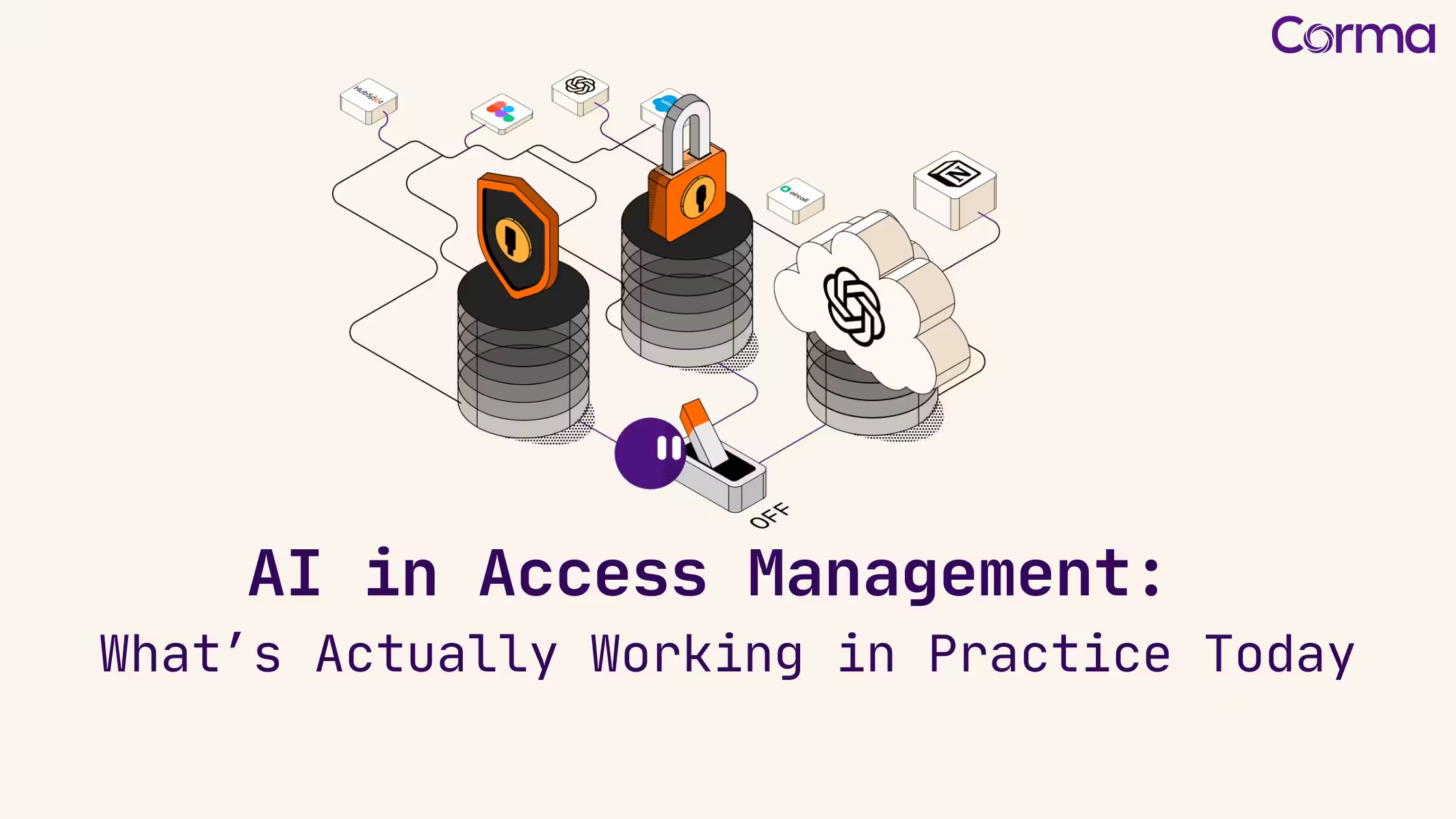
Every IAM vendor today claims their product is “AI-powered.” Most of the time, that means they added a smart-sounding label to a feature that existed three years ago. But if you look past the marketing, there are real things happening in this space that are saving IT and security teams genuine time and reducing real risk.
This article focuses on what is working right now, not what is coming. Four areas worth paying attention to, and one honest section on where the industry is still overpromising.
1. AI in Access Reviews: Giving Reviewers Something to Work With
Access reviews have always had the same core problem. A manager gets a list of names and systems, a deadline, and no context. They have no idea whether the access is being used, whether it still makes sense for the role, or whether anything has changed since it was provisioned. So they approve everything. Not because they are careless, but because they have nothing useful to make a different call.
AI changes this by surfacing the context that was always missing.
Instead of a blank approve/revoke screen, reviewers start seeing real signals. This user has not logged into this application in 90 days. Their role changed three months ago. Everyone else on their team has a lower permission level. That is enough for a manager to say yes, revoke this, instead of clicking through the list as fast as possible.
The result in practice is significant. Teams that previously rubber-stamped entire review cycles start catching genuine over-provisioning, not because they became more diligent overnight, but because the system gave them something to act on.
Dormant Account Detection
The other application that is delivering real value is dormant account detection. Most organisations are carrying far more ghost accounts than they realise. Users who were provisioned for a project, the project ended, and the access never got cleaned up. AI can correlate login activity, HR data, and application usage to surface these accounts automatically, not as a list for someone to manually investigate, but as a prioritised queue where the case for revocation is already clear.
From a compliance perspective, this matters beyond the security benefit. You stop relying on “we have a process” and start being able to demonstrate what happened, when, and based on what data.
2. Anomaly Detection: Smarter Than It Used to Be
Anomaly detection is probably the most mature AI application in access management today. It has been part of SIEM and UEBA tooling for years, but the earlier versions generated so many alerts that security teams learned to ignore them. What has improved is context.
A useful anomaly alert understands who is doing what and whether that behaviour is normal for that specific person. A DevOps engineer accessing a production database late at night is probably doing their job. A marketing manager doing the same thing is not. Good systems today can make that distinction because they build behavioural baselines at the user and role level, rather than firing on generic patterns that apply to everyone the same way.
Use Cases That Work Well in Real Environments
- Credential sharing detection catches multiple people using the same account from different devices or locations in a short window. It is more common than most organisations want to admit, particularly with shared admin credentials or team tool accounts that were never properly individually provisioned.
- Privilege escalation patterns flag a user who starts accessing systems well outside their normal profile, especially anything touching financial data, customer records, or production environments, without a corresponding role change in the HR system.
- Off-boarding gaps surface former employees generating authentication events weeks or months after leaving because their accounts were never fully de-provisioned. These show up clearly in behavioural anomaly data and are exactly the kind of finding that appears in audits at the worst possible moment.
The Honest Caution
Anomaly detection is only as good as the data feeding it. If the system can only see SSO-connected applications, which for most organisations covers 60% to 70% of the actual application estate, there is a structural blind spot. You cannot detect anomalies in systems you cannot see. The risky access is often in the tools that were never centralised.
3. Role and Access Recommendations: Real Value, Real Limitations
The idea behind AI-driven role recommendations is straight-forward. If you look at what people in similar roles following RBAC actually use day to day, you can build access policies based on real behaviour rather than organisation-chart assumptions from two years ago.
Most organisations have access roles that are either too broad or so granular that nobody maintains them. Role mining using AI looks at actual usage patterns and identifies natural clusters: groups of users who consistently access the same set of applications regardless of what their job title technically says.
Where It Works Best
The on-boarding use case is where this delivers the most obvious value. A new hire joining a specific team gets provisioned based on what people in that exact team actually use, not a generic template that was last updated when the company was half its current size. Less friction, less over-provisioning, fewer follow-up access requests in the first two weeks.
Access drift detection works from the same logic in the other direction. When someone’s actual access has diverged significantly from their peer group, that is worth investigating. Either their role has genuinely evolved and the policies need to catch up, or they have accumulated access through one-off requests that should not have stayed permanent.
The Real Limitation
These recommendations are only as accurate as the coverage underneath them. If a meaningful share of your application estate sits outside centralised visibility, the AI is building recommendations on incomplete information. It will generate confident-looking suggestions while missing an entire category of tools it simply does not know about.
4. Where the Hype Is Still Ahead of the Reality
It is worth being specific here because several areas of AI in access management are being sold as ready when they are not.
Cosmetic AI
A lot of vendors have put AI branding on products whose underlying logic has not changed. If the platform still requires manual data imports, relies on periodic snapshots instead of continuous monitoring and uses human-built rules to trigger anything meaningful, the AI is decorative. Real AI-assisted governance needs continuous, integrated data flowing from across the application estate. A spreadsheet with a chat-bot attached is not that.
Natural Language Access Requests
The idea that an employee can ask for access in plain English and the system will handle it end to end sounds compelling. The problem is that access requests carry organisational context that is genuinely difficult to automate: who needs to approve it, what the compliance implications are, whether it should be temporary or permanent, whether it conflicts with existing entitlements. Current systems manage this in narrow, well-defined scenarios. In real environments where the edge cases are the majority, it breaks down. It is being worked on. It is not ready for production governance today.
Fully Autonomous Access Decisions
For low-risk, well-defined situations such as re-provisioning recently revoked standard access or processing identical new-hire bundles, automation makes sense. For anything touching privileged systems or compliance-sensitive data, autonomous approvals are a liability. The implementations that hold up in practice use AI for risk scoring and recommendations, with a human still making the final call on anything consequential.
Predictive Access Provisioning
The idea that the system anticipates what a user will need before they ask for it is appealing in theory. In practice it requires a level of HR data integration, real-time role visibility, and application coverage that most organisations have not yet achieved. This is not a 2026 solution for most teams.
The Foundation Everything Depends On
Across all of these use cases, the pattern is the same. AI in access management works when it has complete, continuous, high-quality data about who has access to what and how that access is actually being used.
The organisations seeing real results are not necessarily the ones with the most sophisticated models. They are the ones that solved the data problem first: full visibility across managed and unmanaged applications, HR lifecycle events connected to access changes in real time, no gaps left to manual processes that fail regularly anyway.
Without that foundation, AI becomes an intelligent layer sitting on top of an incomplete picture. A model that cannot see 30% of your application estate is not protecting you from the risks sitting in that 30%.
Get the visibility right first. That is what makes everything else worth building on top of.
Questions Worth Asking When Evaluating IAM Platforms
If you are looking at platforms that claim AI capabilities for access management, a few questions cut through the positioning quickly:
- What percentage of our application estate will have real coverage, including tools that do not support SCIM, SAML, or SSO?
- Is the AI working from continuous usage data or periodic imports?
- What specific signals do reviewers see during access reviews, such as last login, peer group comparison, and role mismatch?
- How does the platform handle applications without standard protocol support?
- Is there a feedback mechanism that improves recommendations over time, or is it a static model?
The answers will quickly separate genuine integration from a relabelling exercise.
AI is not replacing human judgment in access management. But it is making that judgment faster, better informed, and more consistent. The technology is real. The value is real. It just needs the right foundation underneath it to deliver on what it promises.
Corma’s custom agents in action at Infinox

Corma vs Torii: a practical alternative comparison for IT teams
SaaS Security Posture Management (SSPM): the mid-market guide
The new standard in license management
Ready to revolutionize your IT governance?