RBAC vs ABAC: How to Choose the Right Access Model (2026)
.avif)


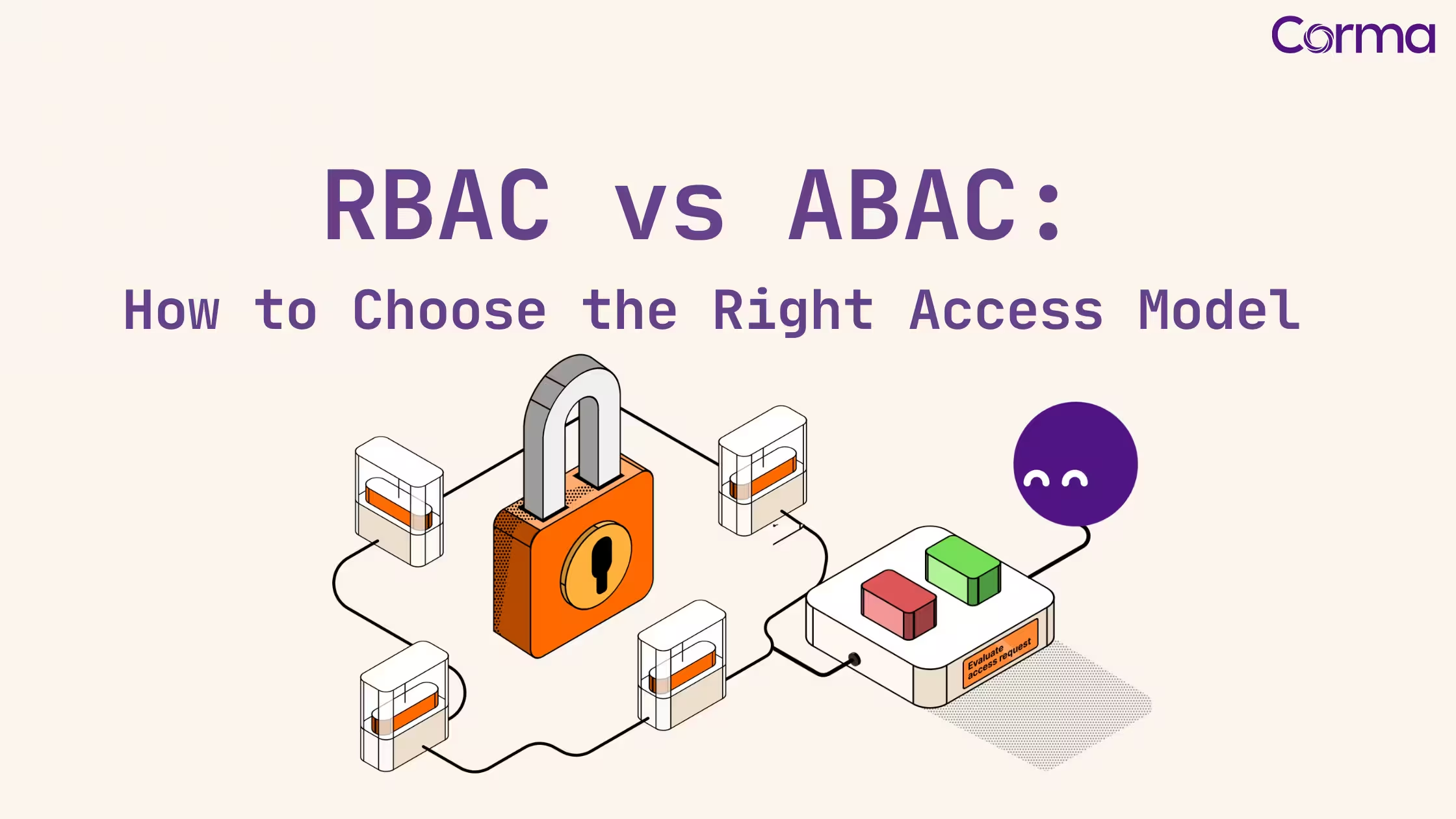
Choosing between Role-Based Access Control (RBAC) and Attribute-Based Access Control (ABAC) is one of the most consequential decisions an IT or security leader will make. The model you pick shapes how fast new hires get access, how efficiently auditors validate ISO 27001, SOC 2 or NIS2 controls, and how much time your team spends fixing entitlement drift.
The wrong fit is expensive. Gartner has consistently flagged that organizations relying solely on static role models hit a wall once they exceed 200 to 300 employees, with role explosion and orphaned permissions multiplying support tickets. On the other hand, jumping straight to ABAC without the right tooling can paralyze a small IT team under policy complexity.
This guide breaks down RBAC vs ABAC in plain terms, with a clear decision framework, hybrid models, EU compliance considerations, and real-world examples. By the end, you will know exactly which model fits your business in 2026, and how to implement it without the typical pitfalls.
What is Role-Based Access Control (RBAC)?
Role-Based Access Control (RBAC) is an access control model that grants permissions to users based on their organizational role rather than their individual identity. Instead of assigning rights person by person, administrators define roles (for example "HR Manager", "Sales Rep", "DevOps Engineer"), attach a fixed set of permissions to each role, and then assign one or more roles to every user.
RBAC is formally defined by the NIST standard ANSI INCITS 359-2012, which specifies four core elements: users, roles, permissions, and sessions. The model is built on three foundational principles:
- Principle of least privilege: users get only the permissions strictly required for their job function.
- Separation of duties (SoD): conflicting roles (such as creating and approving an invoice) cannot be held by the same user.
- Role hierarchy: senior roles inherit permissions from junior roles, simplifying assignment as employees grow.
RBAC is the most widely deployed model today. It is the default in Microsoft Entra ID, Google Workspace, Active Directory, AWS IAM and most SaaS applications. If you want a deeper technical dive, our existing guides cover RBAC with Active Directory and how to design and implement an RBAC model step by step.
RBAC example: a simple SaaS company
Imagine a 150-person SaaS company. The IT team defines five roles: Engineer, Sales, Marketing, HR, and Finance. Each role is mapped to a specific bundle of applications and permission levels. When a new sales rep joins, the IT manager assigns the "Sales" role and provisioning is automated through SCIM to Salesforce, Gong, Slack and Notion. When that person leaves, removing the role revokes everything in one click. Simple, predictable, auditable.
What is Attribute-Based Access Control (ABAC)?
Attribute-Based Access Control (ABAC) is an access control model that grants or denies access based on dynamic policies evaluating multiple attributes of the user, the resource, the action, and the environment at the moment of the request. Instead of static roles, ABAC uses logical rules ("if-then" policies) that combine these attributes to make context-aware decisions.
ABAC is formalized by NIST Special Publication 800-162 and is closely associated with the XACML standard (eXtensible Access Control Markup Language). A typical ABAC policy looks like this in plain English:
Example ABAC policy : "Allow access to the customer database if the user is in the Sales department and their employment status is active and the request originates from a corporate device and the time is within business hours and the data does not include records flagged as restricted."
The four attribute categories evaluated by an ABAC engine are:
- Subject attributes: who the user is (department, job title, clearance level, location, manager).
- Resource attributes: what they are accessing (data classification, owner, project, sensitivity).
- Action attributes: what they want to do (read, write, delete, export, share).
- Environment attributes: the context of the request (time, device posture, IP range, geolocation, MFA status).
Common ABAC implementations rely on policy engines such as Open Policy Agent (OPA), AWS Verified Permissions, Axiomatics, or PlainID. Cloud-native platforms (AWS IAM, Azure RBAC with conditions, Google Cloud IAM Conditions) increasingly support ABAC-style attribute conditions on top of their RBAC core.
RBAC vs ABAC: 8 key differences at a glance
The two models differ across almost every dimension that matters: how access decisions are made, who maintains the policies, how well they scale, and how easily they map to compliance frameworks. The table below summarizes the eight differences IT leaders care about most.
When to use RBAC: best-fit scenarios
RBAC remains the right default for most small and mid-sized businesses, especially in the 50 to 500 employee range. It is fast to deploy, easy to explain to auditors, and natively supported by every major identity provider and SaaS application.
RBAC is the right fit when:
- Job functions are stable and well defined. Your organization has clear departments, predictable workflows, and limited cross-functional access needs.
- You manage 50 to 500 employees. RBAC scales smoothly within this range without role explosion.
- You need fast time to compliance. ISO 27001 Annex A.5.15 and SOC 2 CC6.1 are easier to evidence with role-based access.
- Your IT team is lean. RBAC is cheaper to operate because it does not require dedicated policy engineers.
- Most apps are SaaS. SCIM and SAML provisioning works natively with role mappings, allowing automated user provisioning across SaaS apps.
Real-world RBAC example: a 200-person fintech
A 200-person European fintech defines 12 roles aligned with its org chart (Engineering, Product, Sales, Customer Success, Compliance, Legal, Finance, HR, Marketing, Data, Security, Executives). Each role is mapped to a curated SaaS bundle. Onboarding takes 30 minutes instead of two days. During the annual ISO 27001 audit, the security lead exports the role-permission matrix from the IAM platform and the access reviews report. Audit time on access controls: cut from three weeks to four days.
When to use ABAC: best-fit scenarios
ABAC shines when access decisions need to factor in context that a static role simply cannot capture. Think of access patterns that change minute by minute, depend on data sensitivity, or must respect strict regulatory boundaries (data residency, healthcare records, classified information).
ABAC is the right fit when:
- You operate at large scale (typically 1,000+ users) where pure RBAC creates hundreds or thousands of roles.
- Access depends on context: device posture, geolocation, time of day, network zone, MFA status.
- You handle highly sensitive data: healthcare (HIPAA), defense, legal records, or financial trading.
- Your environment is multi-tenant or project-based (consulting firms, MSPs, large engineering teams with mixed customer data).
- You implement Zero Trust. ABAC is the policy layer that makes "never trust, always verify" practical at runtime.
Real-world ABAC example: a healthcare SaaS platform
A health-tech vendor serves 200 hospital customers. A nurse should access patient records only if the patient is in their assigned ward, the shift is active, the device is enrolled in MDM, and the request originates from the hospital network. No static role can express that. An ABAC policy in OPA evaluates these attributes for every API call. Result: fine-grained control, full auditability, and a security posture that satisfies both HIPAA and NIS2.
Can you combine RBAC and ABAC? Hybrid models explained
Yes, and in 2026 most mature IAM programs do exactly that. The pure RBAC vs ABAC debate is largely outdated: leading organizations layer attributes on top of roles, creating a hybrid model that captures the simplicity of RBAC and the flexibility of ABAC.
The three hybrid patterns you should know
- RBAC + ABAC overlay: roles handle the "who can do what" baseline, attributes refine "under what conditions". Example: "the Sales role can read deals, but only deals where deal.region == user.region".
- PBAC (Policy-Based Access Control): a unifying framework where policies orchestrate roles, attributes and rules. PBAC is what most modern IGA platforms actually deliver, even when they are sold under the ABAC label.
- ReBAC (Relationship-Based Access Control): popularized by Google's Zanzibar and tools like SpiceDB or Permify, ReBAC grants access based on relationships ("is owner of", "is member of", "is reviewer for"). It complements RBAC particularly well for collaborative SaaS and multi-tenant apps.
Key insight : You almost never need to choose between RBAC and ABAC in absolute terms. Start with RBAC as your foundation (fast, auditable, well understood) and add ABAC conditions only where context-aware decisions create real risk reduction or business value.
RBAC vs ABAC and EU compliance: ISO 27001, NIS2, GDPR
European regulations have raised the bar on access governance, and your choice of model affects how quickly you can evidence compliance. Both RBAC and ABAC can satisfy major frameworks, but the audit trail and effort differ significantly.
ISO 27001:2022 (Annex A.5.15, A.5.16, A.5.17, A.5.18)
ISO 27001 requires documented access control policies, formal user access provisioning, and periodic access reviews. RBAC maps to these controls cleanly: the role-permission matrix is the policy, the joiner-mover-leaver workflow is the provisioning, and the access review is a quarterly walk-through of role assignments. ABAC adds value here by automating policy enforcement, but you still need a clear governance layer above it. Our complete ISO 27001 and IAM implementation guide walks through every control in detail.
NIS2 Directive (effective since October 2024)
NIS2 Article 21 mandates "appropriate access control" with specific emphasis on least privilege, MFA, and monitoring. Hybrid RBAC + ABAC is the most defensible approach for essential and important entities under NIS2, because it allows context-aware enforcement without losing the auditability of static roles. Read more on what NIS2 means for your business.
GDPR Article 32 (security of processing)
GDPR requires that access to personal data be restricted to the minimum necessary. ABAC is particularly powerful here because it can enforce purpose limitation at the policy level (for example "deny access to EU citizen records for non-EU users unless explicitly authorized for cross-border processing"). Combined with EU data residency, hybrid access control significantly reduces breach surface and DPA risk.
Compliance comparison: RBAC vs ABAC
Most comparisons skip this part, yet it is where projects succeed or fail. The total cost of an access control program is not the license fee. It is the human time spent designing roles, writing policies, reviewing access, and remediating drift.
RBAC: predictable but watch role explosion
A clean RBAC rollout for a 200-person company typically requires:
- 2 to 4 weeks of role engineering with HR and managers.
- Quarterly access reviews, roughly 4 to 8 hours per cycle if automated.
- Ongoing role hygiene: deprecating obsolete roles, splitting overloaded ones.
The hidden cost is role explosion. Without discipline, organizations end up with one role per edge case (typically 3 to 5 roles per employee in unmanaged environments). When you cross 1,000 roles for 500 users, your RBAC has effectively become a worse version of ABAC.
ABAC: powerful but front-loaded
An ABAC implementation requires:
- A policy engineering function (often 0.5 to 1 FTE for a mid-market company).
- Attribute hygiene: HRIS, CMDB, IDP and asset inventories must agree on every attribute used in policies.
- Policy testing and decision logs to debug "why was this access denied?" tickets.
- Typically 3 to 6 months to reach steady state for a structured program.
The hidden cost is policy debt: badly written policies that nobody dares touch because nobody fully understands them anymore. Treat policies like code: version control, code review, and tests are non-negotiable.
Decision framework: how to choose between RBAC and ABAC
Use the decision matrix below to identify your starting point. Most organizations should land on RBAC or hybrid RBAC + ABAC. Pure ABAC is justified only in specific high-complexity environments.
The 5-step path to a working access model
- Inventory your apps and identities. You cannot govern what you do not see. SaaS discovery is step zero.
- Define 8 to 15 core roles aligned with your org chart, mapped to your top 20 SaaS apps.
- Automate provisioning and deprovisioning via SCIM, SAML or native API integrations to your IDP (Microsoft Entra ID, Okta, Google Workspace, JumpCloud).
- Run quarterly access reviews. This is the single most underused control in mid-market companies and the easiest audit win.
- Add ABAC conditions surgically: production environments, customer data, financial systems. Do not boil the ocean.
How Corma supports RBAC and access governance
Corma is the European SaaS Management and Identity Access Management platform built for IT teams that need RBAC done right, with the option to layer attributes where it matters. Where most platforms force a choice between SaaS Management and IAM, Corma covers both, in one EU-hosted, GDPR-native solution certified ISO/IEC 27001:2022.
Corma supports your access control program across three dimensions:
- Automated provisioning and onboarding: Corma assigns the right SaaS apps and permissions the moment a new hire's role is set in your HRIS, with native SCIM and SAML integrations to Microsoft Entra ID, Google Workspace, Okta and JumpCloud. Read more about automated provisioning with Corma.
- Compliant access reviews: quarterly campaigns are launched in one click, managers certify their team's access in minutes, and exportable evidence packs satisfy ISO 27001, NIS2 and SOC 2 auditors. See how Corma automates access reviews.
- Identity governance and full visibility: every account, license and entitlement is tracked in real time, including shadow IT. Discover the Corma identity governance and compliance engine.
For European companies in scope of NIS2 or DORA, Corma is the IAM partner that combines EU data residency, ISO 27001 certification, and a Gartner® Magic Quadrant™ recognition for SaaS Management Platforms (2025). Customers like Apgar have automated their IAM end to end, and security teams across mid-market Europe rely on Corma's solution for security teams to stay compliant without slowing the business down.
Ready to bring RBAC, access reviews and provisioning under one roof? Book a demo
FAQ: RBAC vs ABAC
What is the main difference between RBAC and ABAC?
RBAC grants access based on a user's assigned role, while ABAC evaluates multiple attributes (user, resource, action, environment) at the moment of the request. RBAC is static and predictable, ABAC is dynamic and context-aware.
Is ABAC better than RBAC?
Not universally. ABAC offers finer granularity but costs more to design and maintain. For most small and mid-sized businesses, RBAC delivers a better return on investment. Large enterprises, regulated industries and Zero Trust programs typically benefit more from ABAC or a hybrid model.
Can RBAC and ABAC work together?
Yes, and most modern IAM programs use a hybrid approach. RBAC handles the baseline ("who can do what") and ABAC adds context-aware conditions ("under which circumstances"). This pattern is sometimes called PBAC (Policy-Based Access Control).
What is PBAC and how does it relate to RBAC and ABAC?
PBAC (Policy-Based Access Control) is a unifying framework where access decisions are governed by central policies that can incorporate roles, attributes and rules. In practice, most enterprise IAM platforms today implement PBAC even when they market it as ABAC.
Does ISO 27001 require RBAC or ABAC?
ISO 27001:2022 does not mandate a specific model. It requires documented access control, least privilege, formal provisioning, and periodic access reviews (Annex A.5.15 to A.5.18). Both RBAC and ABAC can satisfy these controls; RBAC is generally faster to evidence in an audit.
Is ABAC the same as Zero Trust?
No, but ABAC is one of the policy mechanisms that makes Zero Trust practical. Zero Trust is an architectural philosophy ("never trust, always verify"), and ABAC provides the runtime, attribute-based enforcement that allows continuous verification at the policy decision point.
How many roles is too many in RBAC?
A common rule of thumb: if you have more roles than employees, you have role explosion. For a 200-person company, 10 to 25 well-designed roles is healthy. Beyond 100 roles, you should either consolidate or move to a hybrid model with attribute conditions.
What is the best access control model for European mid-market companies?
For European companies between 50 and 500 employees, RBAC backed by automated provisioning and quarterly access reviews is the optimal starting point. Add ABAC conditions on sensitive systems (production, customer data, financial tools) and EU compliance becomes straightforward across ISO 27001, NIS2 and GDPR.
Conclusion: pick the simplest model that solves your real problem
RBAC vs ABAC is not a question of which is technically superior. It is a question of which model matches your scale, your risk profile, your compliance scope, and your team's bandwidth. For 90% of European mid-market companies, the right answer is: start with a clean RBAC foundation, automate provisioning and access reviews, then add ABAC conditions where context truly matters. That hybrid path delivers the fastest path to ISO 27001, NIS2 and GDPR compliance, without the policy debt of a premature ABAC rollout.
Corma is built for this exact journey. Book a 30-minute demo and we will walk you through how to design your role model, automate joiner-mover-leaver workflows across your SaaS stack, and run audit-ready access reviews in your first quarter.
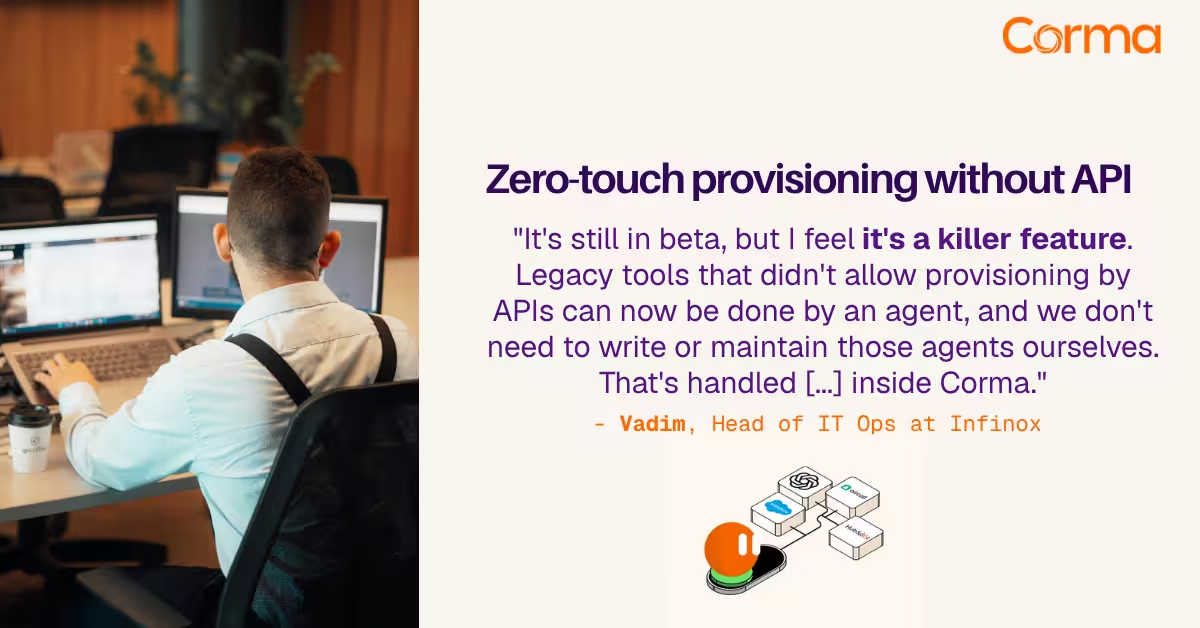
Corma’s custom agents in action at Infinox

Corma vs Torii: a practical alternative comparison for IT teams
SaaS Security Posture Management (SSPM): the mid-market guide
The new standard in license management
Ready to revolutionize your IT governance?