The IT Circle: Interview with Manuel Cuesta, CIO Rubis


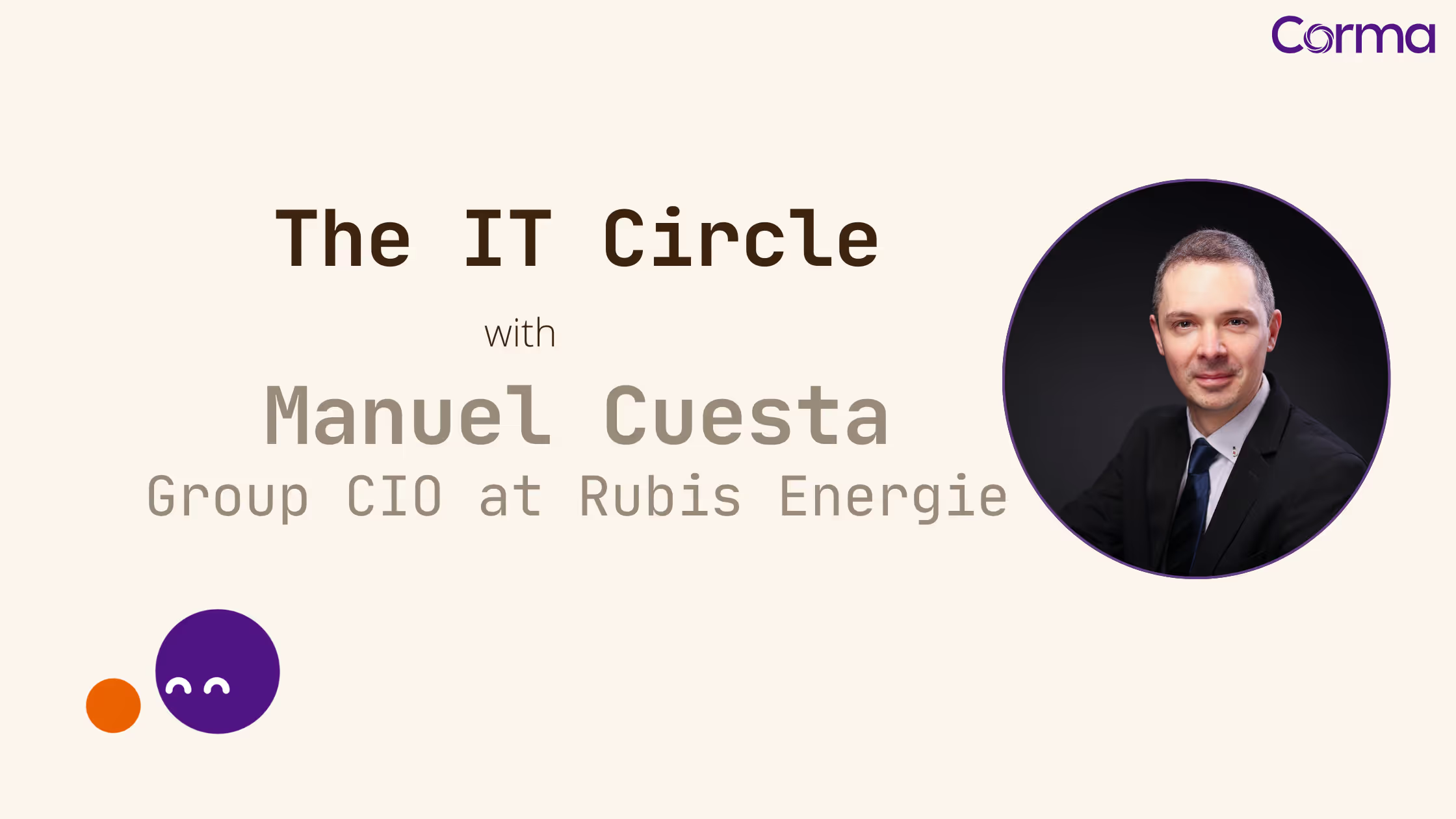
Interview with Manuel Cuesta, Group CIO at Rubis Energie.
In this conversation, Manuel shares what really makes IT leaders effective over time: not just technical depth, but the ability to build relationships and connect very different people. He illustrates this with a defining project at DHL, where the success of an on-call transfer depended far more on trust, incentives, and change management than on technology. On AI, he sees a shift comparable to the arrival of the Internet, with a major challenge: education. For him, CIOs must act as translators, helping organizations move from hype and assumptions to real understanding. He also stresses why visibility into the application and asset landscape has become essential, especially as SaaS expands the perimeter of the information system, often beyond what IT thinks it owns. Looking ahead, he expects the CIO role to become less infrastructure-centric and more focused on two pillars: cybersecurity (identity and access) and architecture (making a growing SaaS stack actually work together, with coherent data).
What advice would you give to someone starting out in IT in 2026: best practices and mistakes to avoid
Manuel points out a paradox: IT is deeply technical, but many of the most complex challenges quickly become human. Engineering and business schools teach technologies well (coding, projects, systems), and that technical base is what gives credibility. But as a career progresses, success depends more and more on relationships, influence, and the ability to bring people together.
His main advice is not to invest everything in being “only technical”, even in highly valued areas like AI or cybersecurity. He recommends spending real time building a network, getting exposure to different domains, and learning how to interface with very different profiles.
He also encourages early-career professionals not to stay too long in their first company. Experiencing different contexts in the first 10 years accelerates learning and expands perspective. Consulting can help through frequent mission changes, but the core idea is to move and see multiple environments.
💡 “As you progress, the hardest problems become highly human. Technology is the foundation, but projects succeed because of relationships and the ability to connect the right people”
Tell me about the IT project you are most proud of
Manuel describes a defining experience from his second role, at DHL International. He was an IT project manager working on a range of technical initiatives, but one project stood out: transferring IT on-call duties from France to an operational center in the UK, as part of building a European cluster.
What made it memorable was that the technology component was relatively small, while the human dimension was huge. On-call work directly affects people’s lives, and it often comes with significant compensation. Manuel’s concern was simple: how do you remove on-call duties from five people and still make the project a success?
He focused on understanding the reality behind the change:
- multiple lunches with the French team to understand constraints and motivations
- travel to the UK to meet the team taking over, as real people, not “a country”
- work with HR to find flexibility, including compensation adjustments
After about six months, the transfer was completed. For the French team, it removed the burden of on-call constraints, and Manuel managed to reintegrate a large portion of on-call pay into their fixed salary. On the UK side, strong professionalism, procedures, and a long shadowing period helped them handle even difficult incidents.
For Manuel, it was the first project where IT success clearly came from the human link more than the technical system.
💡“It was an IT project, but what made it work was lunches, coffees, and building trust between people.”
What impact have you seen from AI tools in an already complex SaaS environment?
Manuel sees AI capabilities in SaaS as accelerators. Many of these features are hard to deploy on-premise, so SaaS makes adoption easier and faster.
The limiting factor today, in his view, is training and knowledge. He observes a lot of fantasies and misunderstandings, with many things not said clearly or not understood. Even he feels there is still a lot to learn.
He considers AI a true revolution, comparable to the emergence of the Internet. Many people now use these tools to get “80% of the work done”, but there is still a learning gap in how they function and how to use them responsibly and effectively.
That is why he believes CIOs and technical leaders must act as explainers and translators, similar to how organizations previously had to educate users about email, the Internet, connectivity, and office software
💡“We need CIOs who explain and translate. AI is still blurry for many people, and that creates an adoption barrier.”
How important is IT visibility into the application landscape to reduce security risk?
Manuel links visibility directly to targeted cybersecurity. As attacks become more targeted (he references the idea of APTs, advanced persistent threats), defenses also need to be targeted. Organizations often talk about identifying the “crown jewels”, the most critical assets in the information system.
But that only works if you have a sufficiently exhaustive view of what assets you actually have. Software Asset Management aiming for total discovery, he sees the first step as knowing what exists, before deciding how to protect it.
The key challenge is that SaaS has expanded the perimeter of the information system. Even in mid-sized organizations, IT often does not fully know what is used, because the real information system is larger than what people think.
Building visibility, including SaaS usage, is the starting point for regaining control of scope and therefore reducing risk.
💡“Before deciding how to protect, you need to identify what you must protect. SaaS made the information system bigger than we think.”
What are best practices for IT communication with the rest of the organisation?
Manuel frames communication with three parameters:
- variety (do not always communicate in the same way)
- intensity (quality and substance)
- frequency (the most important one for him)
If communication is not frequent enough, IT ends up communicating only during crises. Then the perception becomes: every time people hear from IT, something is wrong. By communicating regularly (status updates, newsletters, any channel), IT builds proximity and trust, because users remember all the “trains that arrived on time”, not only the incidents.
Regular contact makes tough moments easier, because the relationship already exists.
💡 “If you do not communicate often, you only communicate during crises. Frequency changes perception and builds trust.”
What will the CIO role look like in 5 to 10 years?
Manuel expects the biggest shift to be around infrastructure. By infrastructure, he means data centers, telecom, servers, and virtualisation. Even if there are some swings back to on-premise, he believes the long-term movement toward cloud is structural. That means less focus on hardware and low-level layers, and more focus on applications.
This leads to a common question: if everything is SaaS, what is left for the CIO?
For him, two areas remain essential:
- Cybersecurity, especially identity management and access control, ensuring permissions and authorizations are mastered.
- Architecture, because having 100 SaaS apps is not enough: at some point, the organization needs them to communicate, exchange data, and remain coherent. APIs, integration, and data consistency become foundational. Too often people assume this layer is already solved, and want to add AI or BI “on top” of fragmented and inconsistent data.
So the CIO of tomorrow is less an infrastructure expert and more the person who secures the system and assembles the overall architecture.
💡“The CIO of tomorrow guarantees cybersecurity and acts as the architect who connects all the technologies. Without coherent data, everything on top is fragile.”
How do you think about IT training and continuous learning?
Manuel believes IT professionals, and scientists more broadly, usually like learning, which creates fertile ground for continuous development. The pace of change in digital is also a forcing function: unlike heavy industry where assets can remain stable for decades, applications rarely remain stable for even a few years.
He sees continuous learning as natural and structural in IT. There are also many enablers now: e-learning platforms and growing communities.
His practical advice is to vary learning modes as much as possible:
- hands-on practice
- theory and structured learning
- discussions with others and peer exchange
He also encourages seeking multiple perspectives, especially in a period where there are fewer certainties, such as with AI. Several viewpoints lead to a more accurate understanding than committing to a single narrative.
💡 “Vary how you learn and seek multiple perspectives. With AI, there are fewer certainties, so you need different viewpoints to build a solid understanding.”
%20acquired%20by%20Workday.avif)
Workday to acquire C1: what it means for ConductorOne customers

Freshworks to acquire Torii: what it means and how to switch

JumpCloud pricing 2027: plans, free tier limits and real cost per user
The new standard in license management
Ready to revolutionize your IT governance?