Corma vs Torii: a practical alternative comparison for IT teams
.avif)


Corma and Torii both promise the same headline outcome: you know which applications your company uses, who has access to them, and what they cost. They get there from different starting points, and those starting points decide which one fits your team.
This comparison is written by Corma, so read it with that in mind. What we can offer instead of neutrality is precision: everything below about Torii comes from Torii's own documentation, product pages and legal pages, not from review sites or third-party comparison content. Where Torii is the better choice, we say so. The state of both products is as of September 2026, and Torii ships frequently, so check anything that matters to your decision against their current documentation.
The short version
Torii is built around SaaS operations: broad discovery, a wide integration catalogue, and a workflow engine with an unusually well-designed set of triggers. Corma is built around identity: every application, licence and euro traces back to a person and their access, which is what turns access reviews, joiner-mover-leaver automation and licence clean-up into one workflow rather than three.
If your problem is running a large SaaS estate, Torii is a serious product and you should evaluate it properly. If your problem is proving who has access to what, to an auditor, on EU-hosted infrastructure, Corma is the closer fit.
The rest of this article works through that difference in detail. If you prefer it as a table, our Corma vs Torii comparison sets both products side by side across identity and access, discovery and shadow IT, cost and licences, and commercials.
How the data gets in
Discovery is where comparisons usually stop at a number of integrations. The more useful question is what happens to the applications that integration catalogues do not reach.
Corma
Corma runs connectors in two mechanisms. The first is a conventional server-to-server API integration. The second drives the target application's own admin interface in a browser session, for applications that have no usable API, or whose API sits behind a plan you do not buy. That second path is a supported connector type rather than an engineering project on your side.
Beyond connectors, data arrives from:
- Identity providers: Google Workspace, Microsoft Entra ID, Okta, plus OneLogin and JumpCloud. Users can be scoped by organisational unit or security group. Both major IdPs also return third-party OAuth grants, which is where token inventory comes from.
- HR systems: Factorial, Personio, Lucca, Deel, HiBob, Rippling, Workday, BambooHR, Payfit and Eurécia. This is what populates start dates, termination dates and team data, and what feeds the suggested queue for offboarding.
- Finance and accounting: Moss, Spendesk, Pennylane, Qonto, Payhawk, Candis, Agicap and Tomorro, so that actual spend can be compared against licence-based cost.
- A browser extension for Chrome, Safari, Brave, Edge, Firefox and Arc, with silent authentication and several documented deployment paths. It collects anonymised data about professional software use, filtered by a URL whitelist before anything is stored.
- A Windows OS agent, deployed through Microsoft Intune as a line-of-business app.
- Manual paths: CSV import for licences, contracts, invoices and expenses, and a public API.
One honest limitation worth stating up front: the OS agent is Windows only. If your fleet is Mac-first, your coverage comes from the browser extension and integrations, not from the agent.
Torii
Torii documents four sources for usage data: SSO, desktop agents delivered through your MDM, their own browser extension, and direct integrations. Device-level data depends on you already running an MDM - they name Jamf, Kandji, Microsoft Intune and JumpCloud. For applications they do not integrate with, the documented route is a custom integration that pushes data in, which according to their documentation covers users, licences, roles and last-used dates but not expenses and contracts, or a CSV re-uploaded to resync.
Deterministic versus indicative
Corma labels where each record came from. Data from an integration is deterministic: it comes from an authoritative source. Applications merely detected through an IdP, the browser extension or the desktop agent are indicative. Both are shown, and they are marked differently. It is a small thing that matters a lot the first time someone challenges a number in front of a CFO.
What you can see, and what you can decide
A few modelling decisions have outsized consequences downstream.
- Unmatched accounts are a named step, not an afterthought. When a detected licence cannot be linked to a known user - different email formats, licences on mailing groups, accounts with a username and no email, former employees with live licences - Corma surfaces it as an explicit queue with ranked suggestions, instead of silently dropping the row.
- Licence types and licence roles are separate. How many Enterprise seats you consume and how many administrators you have are different questions about the same application, and you can answer both.
- Billing status and activity status are separate fields. A licence can be live and inactive at once. That is the entire basis of licence clean-up, and blending the two into a single status destroys it.
- Application risk is assessed on the vendor. Corma computes it from hosting location, data sensitivity, held certifications and known incident history. Torii documents its application risk levels as being derived from the OAuth scopes users granted through Google Workspace, Entra ID or Slack. That is a useful grant-risk signal, but an application nobody has OAuth-granted does not get scored.
- Lifecycle drift is a field comparison, not a report you build. Active in the identity provider but terminated in HR is two authoritative sources reconciled on the user record, surfaced without configuration.
- Service accounts and AI agents are first-class identity types, not tags on a human user. They carry licences, appear in access reviews, and are offboarded through the same machinery as a person.
Access reviews
Corma runs review campaigns with maintain, revoke and change-access decisions, reviewers resolved dynamically to the application owner, access owner, contract owner or the user's manager, quarterly or yearly recurrence, task creation on completion, and separate CSV exports for decisions and for remediation. Reviews are scoped per application.
Torii's access review module is mature, and any comparison claiming otherwise is out of date. It scopes by application and by user, including a privileged-access scope, supports bulk reassignment and delegate decline, automates remediation, and exports to PDF, CSV or ZIP. If review scoping flexibility is your deciding criterion, evaluate theirs seriously.
Automation
Corma's workflow builder covers the flows that repeat: joiners, leavers, scheduled clean-ups, licence status changes, newly detected applications and inbound tickets. Steps pass values to each other through variables and built-in functions, and every run is visible as a graph with per-step state. Failed steps can be retried or skipped individually, which turns a broken offboarding into a two-click fix rather than a full rerun. Notifications go out by email, Slack or Microsoft Teams.
The part worth a demo is custom agents. Instead of configuring an HTTP call, you perform the task once in a secure browser session and the agent learns it. Credentials never reach Corma - only the session is kept - and the agent keeps working when the vendor moves a button. That is how provisioning and deprovisioning reach applications with no usable API, without an engineer.
Where Torii is ahead: their trigger design is the strongest part of their product. They ship roughly twice as many triggers as we do, and the extra ones are not filler - licence-not-in-use with a per-workflow inactivity override, licence count thresholds per application and licence type, contract-based criteria, inbound webhooks from any external system, and immediate execution on events from Google, Okta and BambooHR. They also offer workflow actions for calculating and transforming values mid-run. If trigger breadth on usage and licence conditions is your deciding criterion, they win it.
API and AI interfaces
Corma's public API covers users, licences, licence types and roles, teams, groups, jobs, workspaces, applications, tasks and tickets. Two design choices stand out: executable actions are discovered at runtime rather than hardcoded, so a caller can ask which actions exist, what payload each needs and whether it is currently available for a given connector; and writes on user and licence creation accept an idempotency key, so a retried provisioning call does not create duplicates.
Corma also runs an MCP server, where an agent gets endpoint discovery plus a universal executor rather than a fixed list of tools - anything the API can do, an agent can do.
Where Torii is ahead, clearly: a hosted MCP server on OAuth 2.0 with PKCE and an official listing as a Claude connector, a downloadable OpenAPI specification, a generated CLI, documented per-endpoint rate limits with proper headers, SCIM v2, custom fields, and API coverage for contracts, transactions and workflows. Their developer surface is more mature than ours. If you are a platform team that wants to build on top of a SaaS management platform today, that difference is real.
Data residency, which decides some evaluations on its own
Corma is ISO/IEC 27001:2022 certified and as a European company with its headquarter in France, is hosting within the EU.
Torii's own privacy notice states that personal data is maintained, stored and processed in the United States, Israel, Canada and other locations, their GDPR page describes Torii as a non-EU business, and transfers rest on standard contractual clauses together with Data Privacy Framework self-certification. We found no documented EU residency or EU region option on their site.
For most buyers this is one criterion among many. For a regulated European buyer it is frequently the whole conversation, and it is worth resolving in week one rather than week six.
Where Torii is the better choice
Conceding this list is not modesty, it is accuracy. Torii is the better fit when:
- You want a mature developer and agent surface today - OpenAPI, CLI, SCIM, a hosted MCP server.
- Contract ingestion is the bottleneck. They accept contracts by email with AI parsing, sync continuously from Ironclad, Zip and Coupa, and extract line items automatically.
- Your stated problem is AI tool inventory. They ship a second extension built specifically for discovering AI tools and their configuration.
- You want licence cost benchmarks and renewal forecasting out of the box.
- You are a larger established enterprise.
Where Corma fits
- EU data residency is a hard requirement.
- Part of your estate has no usable API, and you are tired of hearing that it cannot be automated.
- You are a growing IT, security or compliance team that has to prove who had access to what, and when it was removed.
- Service accounts and AI agents need to be governed like people, not tracked in a spreadsheet.
- You want employees to self-serve - request access, see what they hold, and hand back what they no longer need - instead of queueing in your inbox.
- You are a smaller, mid-size or growing company
How to evaluate either of us
Three questions cut through most SaaS management demos. First, how many joiners and leavers do you process a month, and what does a day of lag cost you on a leaver? Second, which of your applications have no usable API, and what exactly happens to those in each platform? Third, when your next audit asks for evidence that access was reviewed and removed, what does the export look like?
The Corma vs Torii comparison answers the first two for both products in a single table. For the third, book a demo and we will walk through a real export.
This comparison is based on publicly available documentation from Torii and on Corma product documentation, as of September 2026. Torii is a trademark of its respective owner. Spotted something out of date? Tell us and we will correct it.
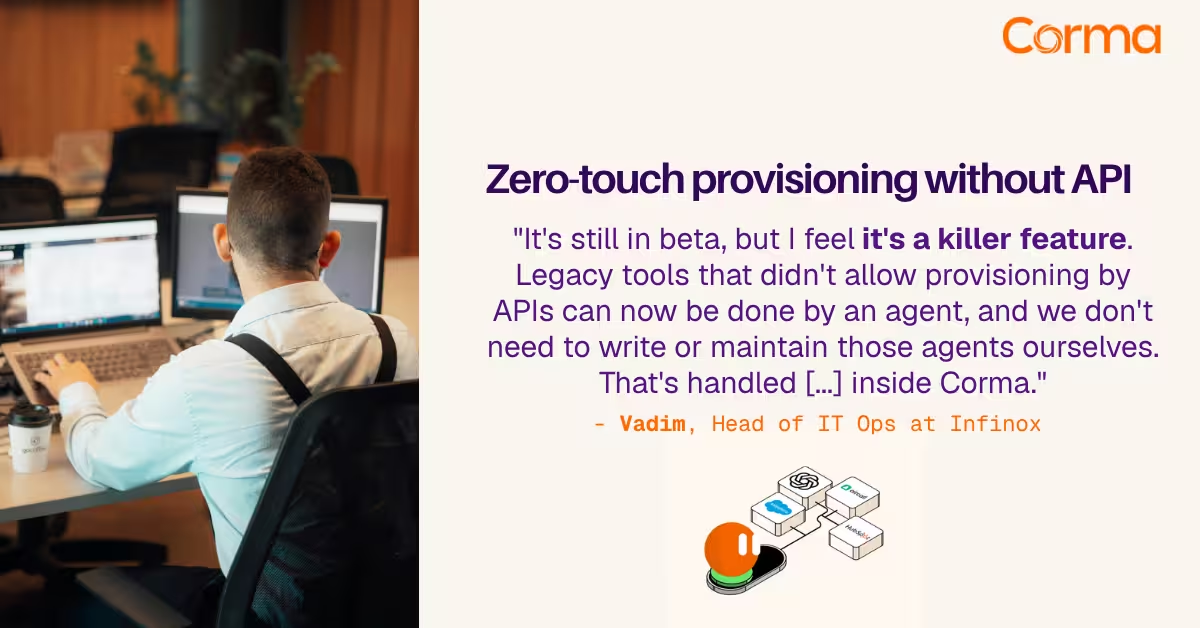
Corma’s custom agents in action at Infinox

Corma vs Torii: a practical alternative comparison for IT teams
SaaS Security Posture Management (SSPM): the mid-market guide
The new standard in license management
Ready to revolutionize your IT governance?