What is SaaS sprawl? Causes, risks & how to fix it (2026)
.avif)


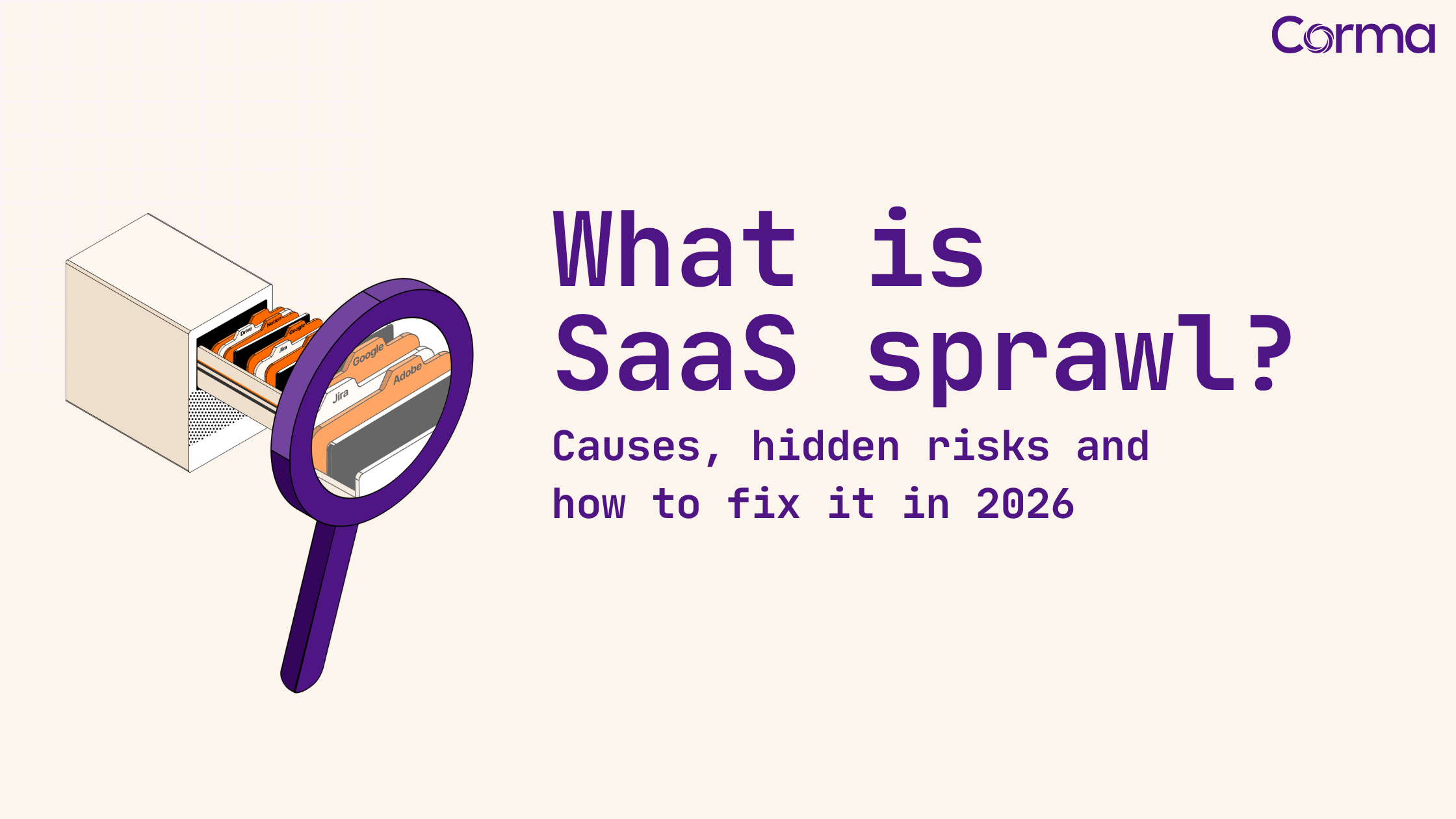
If you've ever tried to compile a full list of software tools your company actually uses, and failed, you're not alone. The average mid-sized company runs between 80 and 150 SaaS applications, and IT teams typically know about only half of them. The rest operate in the shadows, quietly billing your finance team and exposing your organisation to risks nobody has mapped.
This is SaaS sprawl, one of the most common, costly, and underestimated problems facing IT managers in 2026.
What is SaaS sprawl?
SaaS sprawl (also called software sprawl or app sprawl) refers to the uncontrolled proliferation of Software-as-a-Service applications within an organisation, without centralised oversight, governance, or visibility.
It is not simply a matter of having many SaaS tools. SaaS sprawl occurs when no single team has a complete picture of which apps are in use, subscriptions accumulate without formal procurement approval, licences go unused or are duplicated across departments, offboarded employees retain active access to paid accounts, and shadow IT tools operate entirely outside IT's knowledge.
In short, your software stack has grown beyond your ability to manage it, and it's costing you more than you think.
Related: The Silent Crisis: Helping IT Leaders Win the Battle Against SaaS Sprawl
How SaaS sprawl happens: the root causes
SaaS sprawl rarely happens overnight. It builds gradually, driven by a combination of structural and cultural factors that are common across growing companies.
1. Frictionless SaaS purchasing
Modern SaaS tools are designed to be adopted without IT involvement. A team lead can sign up for a project management tool, a CRM add-on, or a design platform with nothing more than a company credit card. When procurement is this easy, volume explodes. Virtual company credit cards with expense tools like Spendesk contribute massively to the sprawl.
2. Remote and hybrid work
The shift to distributed teams accelerated individual software adoption dramatically. Employees working from home needed tools immediately, and they found them, independently. The rise of remote work contributed directly to SaaS adoption rates that IT teams were never prepared for.
3. Decentralised purchasing
In many organisations, each department buys its own tools: Marketing uses its stack, Sales uses another, Finance has its own set. Without a centralised procurement process, the overall footprint becomes impossible to track.
4. Vendor free trials that become paid subscriptions
“Oopsie, I forgot to cancel on time”. This does not only happen with private Netflix subscriptions. A free trial that converts to a paid plan without a formal review is one of the most common sources of zombie apps, tools that nobody actively uses but that keep billing every month.
5. Poor offboarding processes
When an employee leaves, their licences should be immediately deprovisioned. In most companies, this step is delayed, forgotten, or done manually, leaving active accounts on departed users, which is both a cost and a security risk. Read more about how to prevent this in our guide to automating onboarding and offboarding.
6. No centralised SaaS inventory
Without a single source of truth for all applications, renewals go unreviewed, duplicates go unnoticed, and usage data is never analysed. The spreadsheet approach breaks down quickly past 20–30 tools. Ditching the spreadsheet is often the first step toward regaining control.
5 warning signs your company has a SaaS sprawl problem
Not sure if SaaS sprawl is already affecting your organisation? Look for these red flags.
Multiple tools doing the same job.
If different teams are independently running two project management platforms, three communication tools, or two video conferencing subscriptions, that's a direct sign that no one is coordinating software purchasing across the organisation.
Finance has SaaS line items IT can't explain.
When IT reviews the company's software spend and encounters recurring charges for tools no one recognises, shadow IT has already reached the P&L. This is one of the clearest indicators that the software stack is no longer under IT's control.
No one knows the total software spend.
Decentralised purchasing means costs are scattered across team budgets, corporate cards, and departmental expense reports. When no single person can give you a consolidated figure, you're operating blind.
Departed employees still have active accounts.
Offboarding is manual or inconsistent in most mid-sized companies. The result: former staff retain access to paid tools, a live cost item and a significant security vulnerability.
IT only discovers new apps during audits.
If the only mechanism your team has for finding unknown tools is a periodic audit, you have no proactive discovery in place. By the time the audit happens, months of unnecessary spend have already accumulated.
Our article on 6 signs it's time to properly manage your software licences goes deeper into each of these signals.
The real cost of SaaS sprawl
The financial impact of SaaS sprawl is substantial, and often hidden across multiple cost centres, making it easy to underestimate.
Unused licences are the most immediate form of waste. Industry data consistently shows that 20–30% of SaaS licences in a given organisation are never used, or used fewer than once per month. These are pure overhead, paid seats that generate no value.
Duplicate tools add a second layer of cost. When different teams independently buy software with overlapping functionality, the organisation ends up paying multiple times for the same capability. This is particularly common for project management, file sharing, and communication tools.
Missed renewals and auto-renewals are a structural problem in any organisation without centralised contract tracking. When contracts auto-renew without anyone reviewing whether the tool still serves a business purpose, spend compounds silently year after year.
Poor negotiating leverage is a less obvious but equally damaging consequence. When IT doesn't have visibility into the full scope of contracts with a given vendor, it enters renewal negotiations at a disadvantage, and pays more than necessary.
Zombie apps, tools that were once actively used but are now dormant, persist through inertia. Nobody cancels them because nobody knows they exist. They continue billing until someone stumbles across the charge.
The aggregate effect is significant. Companies that conduct a proper SaaS audit typically find 15–25% of their software spend is recoverable without any reduction in operational capability. For a company spending €200,000 per year on software, that represents €30,000–€50,000 in recoverable budget.
Want to understand what this means in concrete numbers for your company? Calculate your SaaS ROI with Corma.
For a finance-focused view of the problem, see The CFO's Guide to Optimising SaaS Spend.
Security and compliance risks
SaaS sprawl is not just a cost problem. It is also a security and compliance risk that IT and security teams cannot afford to ignore.
Shadow IT and data exposure
When employees use unauthorised applications to process company data, that data lives in environments IT has never reviewed, never contracted, and never secured. This is the core of the shadow IT problem, and SaaS sprawl makes it dramatically worse.
In practice, this means data stored in non-compliant environments with no DPA or GDPR clauses in place, credentials shared across personal and professional accounts, no MFA enforced on tools outside IT's control, and no offboarding sweep, meaning data access persists long after an employee has left.
Compliance and audit failures
Frameworks like ISO 27001, SOC 2, and NIS2 require organisations to maintain an accurate inventory of all systems processing sensitive data. A company with untracked SaaS applications cannot pass these audits, and in the case of NIS2, faces significant regulatory penalties in the event of a breach.
Access governance gaps
Orphaned accounts, active user accounts belonging to employees who have left, are among the most common attack vectors exploited in SaaS environments. Without automated deprovisioning, these accounts accumulate silently across dozens of tools, each representing an open door to company data.
How to fix SaaS sprawl: a step-by-step approach
Eliminating SaaS sprawl requires a combination of discovery, governance, and automation. Here is a practical framework IT teams can apply immediately.
Step 1 - Conduct a complete SaaS discovery
Before you can manage anything, you need to see everything. This means connecting to your identity provider (Google Workspace, Microsoft Entra ID, Okta) to pull all OAuth-connected apps, using browser extension data to detect tools that bypass SSO, reviewing bank and credit card statements to surface SaaS billing, and auditing ITSM tickets for software requests. The goal is a single, complete inventory of every application in use across the organisation.
Step 2 - Categorise and classify each application
Once you have your inventory, classify every tool by its business function (which team uses it, for what purpose), its approval status (IT-approved, shadow IT, or unknown), its usage level (active, low-use, or zombie), and whether it processes personal or sensitive data.
Step 3 - Eliminate waste and duplicates
With usage data in hand, you can take action: deactivate unused licences, downsize plans where appropriate, consolidate duplicate tools into a single approved solution per category, and review auto-renewals before they trigger.
Step 4 - Establish a procurement policy
SaaS sprawl grows when purchasing is frictionless. Define a clear process in which all new SaaS purchases above a defined threshold require IT approval, a preferred tools list is maintained and communicated across teams, and employees have a simple, fast channel for requesting new software.
Step 5 - Automate provisioning and deprovisioning
Manual offboarding is the single largest driver of orphaned accounts and ongoing security risk. Automating access lifecycle management, so that accounts are created and revoked in sync with HR events, eliminates this permanently. Corma's user provisioning solution connects directly to your HR system to make this automatic.
Step 6 - Monitor continuously
SaaS sprawl is not a one-time audit problem, it is an ongoing governance challenge. Set up automated alerts for new OAuth connections by employees, usage drops on paid tools, contracts approaching renewal, and accounts belonging to departed users that are still active. Without continuous monitoring, the stack will sprawl again within months of any manual cleanup.
How Corma helps IT teams eliminate SaaS sprawl
Corma is a SaaS Management and Identity Access Management platform specifically built for the kind of IT environment where SaaS sprawl thrives: growing SMEs and mid-market companies with expanding software footprints and limited IT resources.
Complete SaaS discovery.
Corma connects to your identity provider and uses browser extension data to surface every application in use, including those that bypass SSO. Your inventory is built automatically and kept up to date in real time, without manual input from IT.
Real usage data.
Rather than billing data alone, Corma shows you actual usage per licence, so you know exactly which tools and seats are being used, and which are wasted. This is the foundation for any cost optimisation initiative.
Automated licence management.
Corma flags upcoming renewals, identifies underused tools, and helps you act before contracts auto-renew. Companies using Corma typically reduce their SaaS spend by 20–30% within the first few months.
Automated provisioning and deprovisioning.
When a new employee joins or an employee leaves, Corma syncs access automatically with your HR and identity systems, eliminating orphaned accounts and the manual IT tasks that come with them.
Shadow IT visibility.
Corma detects apps operating outside IT's purview and gives you the data you need to either approve, migrate, or block them. See how Corma addresses shadow IT in detail.
Compliance readiness.
With a complete, auditable record of all applications and access rights, Corma makes ISO 27001, SOC 2, and NIS2 audits significantly more manageable, and significantly less stressful.
Discover Corma's automated SaaS management platform or book a personalised demo to see how it applies to your specific environment.
For IT managers taking on a new role, this kind of visibility is especially valuable from day one. Read The First 30 Days as a New IT Manager for a broader strategic checklist.
Corma was built precisely for this challenge
SaaS sprawl is the inevitable result of fast company growth, decentralised purchasing, and a SaaS market designed to remove friction from adoption. Left unaddressed, it translates into wasted budget, security gaps, compliance risks, and an IT team that spends more time firefighting than building.
The good news: it is entirely solvable. With the right discovery process, a clear governance policy, and automation in place for the access lifecycle, most companies can recover 15–25% of their software spend and dramatically reduce their exposure to security incidents, within a matter of weeks.
If your software stack has grown beyond your ability to manage it, start with a free audit and see exactly where you stand.
FAQ
What is the definition of SaaS sprawl?
SaaS sprawl is the uncontrolled accumulation of Software-as-a-Service applications within an organisation, typically without centralised visibility, procurement governance, or active management. It results in wasted licences, security gaps, and runaway IT costs.
What is the difference between SaaS sprawl and shadow IT?
Shadow IT refers specifically to applications used without IT's knowledge or approval. SaaS sprawl is a broader problem: it includes shadow IT, but also encompasses approved tools that are underused, duplicated, or poorly managed. Every shadow IT problem contributes to SaaS sprawl, but not all SaaS sprawl is shadow IT.
How much does SaaS sprawl cost the average company?
Studies consistently show that organisations waste between 20% and 30% of their SaaS spend on unused or underutilised licences. For a company spending €200,000 per year on software, that represents €40,000–€60,000 in recoverable budget.
How do I know if my company has a SaaS sprawl problem?
Common indicators include: inability to list all SaaS tools in use, SaaS billing items that IT cannot identify, duplicate tools across teams, and active accounts belonging to departed employees. If any of these apply, SaaS sprawl is already affecting your organisation.
What is the fastest way to fix SaaS sprawl?
The fastest first step is a complete SaaS discovery audit, connecting your identity provider and financial data to build a full inventory. Tools like Corma automate this process and can surface your entire software footprint in hours rather than weeks.
Does SaaS sprawl create compliance risks?
Yes. Untracked applications processing personal or sensitive data can create direct GDPR, ISO 27001, SOC 2, and NIS2 compliance failures. Orphaned accounts, active access for departed employees, are also a major audit risk and a common attack vector.
Can a SaaS management platform like Corma fully solve the problem?
A SaaS management platform addresses the core mechanics of SaaS sprawl: discovery, licence optimisation, access governance, and automated provisioning. It does not replace a procurement policy, but it gives IT teams the visibility and automation they need to enforce one effectively, and to keep the software stack clean on an ongoing basis.
%20acquired%20by%20Workday.avif)
Workday to acquire C1: what it means for ConductorOne customers

Freshworks to acquire Torii: what it means and how to switch

JumpCloud pricing 2027: plans, free tier limits and real cost per user
The new standard in license management
Ready to revolutionize your IT governance?