IT Circle Interview with Olivier, Independent Business & IT Transformation Leader


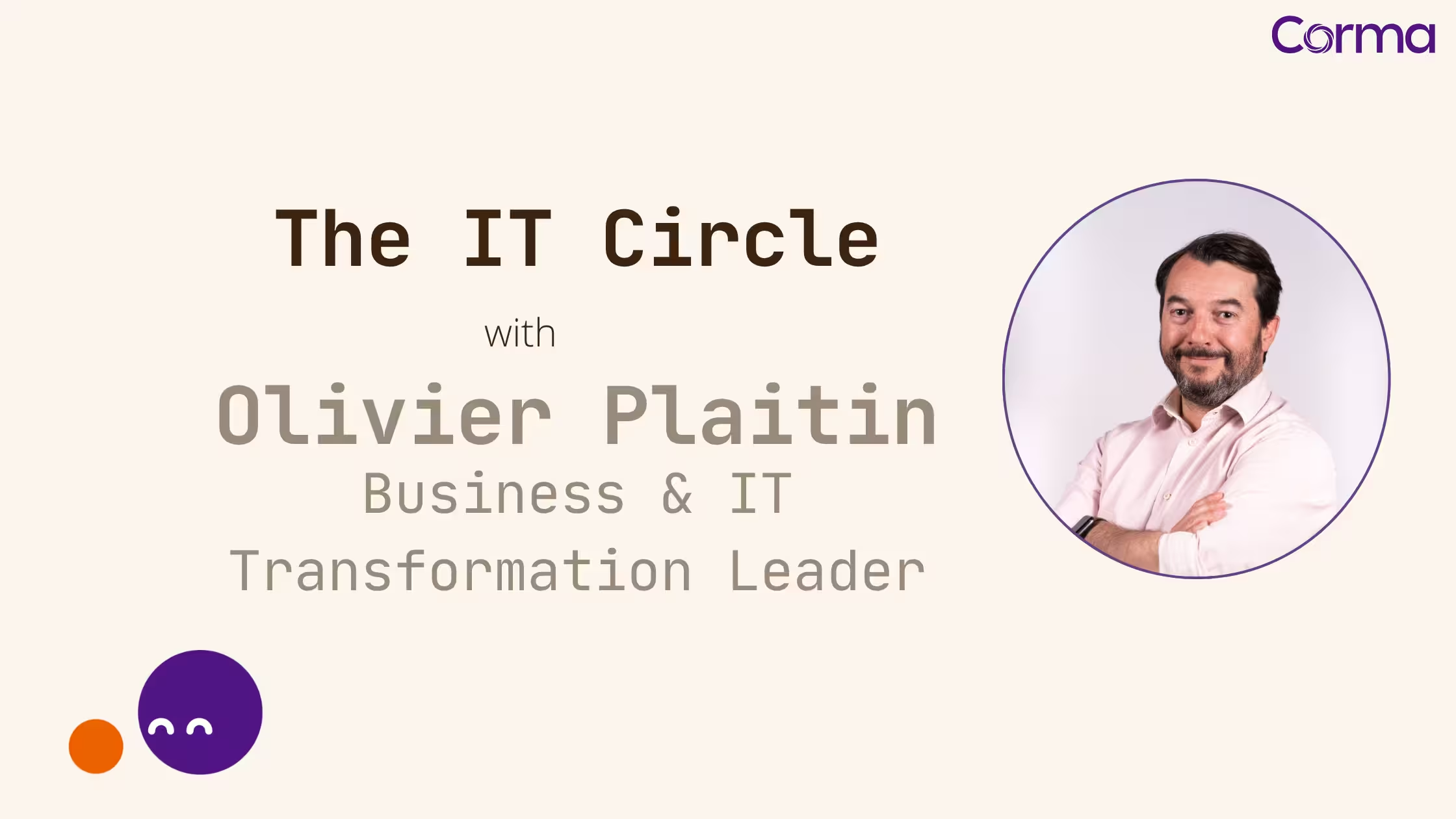
30 years in IT: Interview with Olivier Plaitin, Business & IT Transformation Leader
In this conversation, Olivier draws on over thirty years of IT leadership across aerospace, consumer services and human resources to map out how technology has transformed work in waves, and where it is heading next. Now running his own consultancy after senior roles at companies like Manpower and Lufthansa, he brings a rare combination of global enterprise experience and a genuine passion for helping smaller businesses access the kind of strategic IT thinking that was once reserved for large groups. He is thoughtful on the future of the CIO role, firm on the need for IT to sit at the executive table, and refreshingly practical on what it actually takes to deliver value and earn trust inside an organisation.
Over thirty years in IT, how would you describe the evolution of technology adoption across the industry and within the organisations you have been part of?
When I look back, what strikes me is that nothing is really new. Everything has happened in waves, and each wave has fundamentally transformed the way we work and the relationship between IT and its stakeholders. The first wave was simply the introduction of technology into the workplace. I remember a time when everyone worked on typewriters, first mechanical, then electronic, and then the PC arrived and changed everything. That technology eventually moved into our private lives too, as laptops and personal devices became democratised. The second wave was what we called digitalisation, the moment when marketing and IT came together to build digital platforms and put technology directly in the hands of the consumer, making it a choice rather than an imposition. That movement was accelerated by mobile technology, from BlackBerry to the first iPhones, which put digital tools in our pockets and made them constant companions. Then came the cloud, which allowed us to virtualise infrastructure and consume technology as a service, dramatically lowering barriers to entry and expanding what was possible. That in turn made data central, and we entered what I would call the golden age of information, where organisations began to genuinely understand the value of what they were collecting. And sitting on top of all of that, we now have AI, which is the current wave and brings with it both extraordinary possibilities and serious philosophical questions. Through all of these waves, one thread has run consistently: security. Every new technology brings new vulnerabilities, and the question of how we protect data and privacy has only grown more important with time.
💡 "Every wave of technology has transformed how we work. But through all of them, one thread has remained constant: security. Each new capability comes with new responsibilities."
How did you see those waves play out differently across the various organisations you worked in?
I see three dimensions that were common across all of them, whether in aerospace, consumer services or HR. The first was the human transformation. Beyond the technology itself, what was always fundamental was reshaping organisations to embrace change and adaptability. The second was relevance: not every technology is right for every company, and I have seen organisations spend millions on data and AI programmes only to realise they had no real need for them and had to start over. The lesson there is to ask first what investments will genuinely accelerate your specific business. The third dimension, which I saw consistently across Sodexo, Manpower and others, was rationalisation. Large international groups used to operate in a completely fragmented way, with every country managing its own tools and systems because local legislation and market realities were different. Over time, they all began to identify what was truly common, from laptop management to network operations to licence procurement, and centralise those elements while investing locally only where genuine market specificity required it. Lufthansa took an interesting variation on this, where rather than simply centralising, they specialised each country in a particular domain and had them collaborate as a cooperative model. The underlying principle was the same though: stop spending the same euro twice across different markets.
💡 "The smartest organisations asked themselves what was truly common and centralised it. Then they invested locally only where genuine market specificity demanded it. Stop spending the same euro twice."
What will the CIO role look like in five years?
The role is changing fundamentally, and in a direction that many people might not expect. As we continue to operate at higher and higher levels of abstraction, the need for deep foundational technical knowledge becomes less central. What the CIO of tomorrow will be asked to do increasingly is make decisions that are less purely technological and more ideological or philosophical. The question will not be "how does this technology work" but rather "which AI model do we adopt, what data architecture do we build to feed it, what guardrails do we put in place, and how do we ensure we remain relevant to our customers in this new landscape." In short, CIOs and IT teams will be expected to work alongside the executive committee to help the whole organisation make the right technology decisions for the future. The role becomes less about managing technology and more about managing information and strategic direction.
💡 "The CIO of tomorrow will be asked to make decisions that are less technological and more philosophical. The real question will be which AI model, which data model, which guardrails and why."
Should IT have a more strategic role at the heart of organisations going forward?
It should already be the case today, and in large enterprises it largely is. Having an IT department that reports into the CFO or is not represented at the executive committee is, frankly, an aberration. Technology is not a support function or a productivity tool. It is a strategic accelerator, and every member of the executive committee needs to understand the force that a well-positioned CIO represents. The organisations that invest seriously in their IT strategy and give it a genuine seat at the table are the ones that move fastest. The world is accelerating along a curve that is only getting steeper. Where I still see real gaps is in mid-sized businesses, which is actually one of the reasons I moved into consultancy. These companies face exactly the same challenges as large groups when it comes to security, data and digitalisation, but they do not always have the experience or the internal voice to make technology a genuine part of their strategic thinking.
💡 "Having IT report into the CFO or stay outside the executive committee is an aberration. Technology is not a support function. The companies that understand this are the ones that accelerate the fastest."
What levers do CIOs have to stay aligned with business priorities while delivering real value?
What is fantastic is that beyond the technology itself, there is a rich set of governance frameworks available to CIOs to demonstrate their value. Enterprise architecture, COBIT, ITIL: these all exist to show that when IT strategy is directly tied to business strategy, the organisation comes out stronger. Every euro invested in IT should be traceable to business value. There is no such thing as a purely IT project. Even the most technical initiative has a business justification. Take security: people often ask what the return on investment is. The answer is resilience. At what point does a production outage start costing money? At what point does a failed process start damaging the customer experience? Those are the conversations that IT and finance need to have together. And beyond resilience, I always encourage starting from customer friction points. Ask your clients to name the five biggest pain points they have with you. Those become your IT priorities. Improving customer experience is as legitimate a business outcome as growing revenue, and it is one that every stakeholder can understand and get behind.
💡 "There is no such thing as a purely IT project. Every investment must trace back to business value, whether that is resilience, cost reduction, or a better customer experience."
What advice would you give to young IT companies, especially those working in identity governance and administration?
The first thing is to truly understand what the client is living through. A huge number of mistakes come from unverified assumptions, from a gap between what was said, what was heard and what was understood. Close that gap relentlessly. Second, make small steps. The temptation to think too big, to overpromise, is real and it is dangerous. Not only does it risk credibility, it also underestimates how much trust needs to be built progressively, especially with stakeholders who are sceptical or come in with preconceptions. Baby steps, proven value at each stage, then accelerate once trust and maturity are established. And at every step, explain the why. Communicate clearly what you are doing, what you are aiming for, and what the measurable benefit will be. People are tired of hearing about KPIs in the abstract, but they respond to a clear, honest statement of what success looks like and how you will know when you have reached it. Measure, adjust, stay on course.
💡 "Make small steps, prove value at each one, then accelerate. The organisations that are sceptical at the start become your strongest advocates once they see that it actually works."
Corma’s custom agents in action at Infinox

Corma vs Torii: a practical alternative comparison for IT teams
SaaS Security Posture Management (SSPM): the mid-market guide
The new standard in license management
Ready to revolutionize your IT governance?