Software License Management: How to Track, Optimize and Reclaim SaaS Licenses (2026)


Table of contents
- What is software license management?
- Why software license management matters in 2026
- The four software license types
- The software license management lifecycle
- Manual vs automated license management
- How automated license reclaim actually works
- Software license management best practices
- How to choose software license management software
- Why Corma for software license management
- Frequently asked questions
Most mid-market companies do not have a software spending problem. They have a license visibility problem that looks like a spending problem. Seats keep getting bought, employees leave without their access being revoked, and renewals arrive with no time left to renegotiate. Industry data is consistent on the scale of the waste: Gartner estimates that roughly 25 percent of annual SaaS spend is underutilized or over-deployed, and several vendor analyses put the share of unused enterprise licenses even higher.
Software license management is the discipline that turns that hidden waste back into budget. Done well, it does three things at once: it shows you every license you pay for, it tells you which ones are actually used, and it gives you a repeatable way to reclaim the rest.
This guide explains what software license management is, how the license lifecycle works, and why the most durable cost savings come from tying license reclaim to your identity and access management instead of running it as a once-a-year audit. It is written for IT managers, CIOs, and finance leaders at companies in the 50 to 500 employee range, where SaaS sprawl grows fast but a dedicated IT asset team rarely exists.
What is software license management?
Software license management (SLM) is the process of tracking, controlling, and optimizing all the software licenses an organization owns across its applications. It covers discovering what you pay for, monitoring how each license is used, staying compliant with vendor terms, and reclaiming or right-sizing licenses that are idle or redundant.
In practice, software license management answers four questions on a continuous basis:
- What do we have? Every application, contract, and seat, including the ones nobody officially approved.
- Who uses it? Real login and feature usage, not just the number of seats assigned.
- Are we compliant? Usage stays within the terms you agreed to, with an audit trail to prove it.
- What can we cut? Idle seats, duplicate tools, and renewals that no longer make sense.
The term sits next to two related concepts. Software asset management (SAM) is the broader practice that also covers on-premise and hardware assets. SaaS management is the cloud-native subset focused on subscription apps. For most modern companies, software license management today means SaaS license management first, because the majority of the stack is now subscription-based.
Why software license management matters in 2026
The average mid-market company now runs well over a hundred SaaS applications, and the number keeps climbing as teams adopt AI tools on their own corporate cards. Without active license management, three costs compound quietly.
Wasted spend. Idle and duplicate seats are the most visible loss. When a quarter of subscription spend is underused, a company paying 1 million per year on SaaS is effectively burning around 250,000 on licenses nobody touches.
Security and compliance exposure. A license that is never reclaimed is also access that is never revoked. Former employees, contractors, and abandoned tools become standing entry points. This is where license management overlaps directly with identity governance: an unused license is usually an orphaned account waiting to be found in an audit.
Shadow IT and Shadow AI. Apps bought outside of IT never make it onto the spreadsheet, so they are never tracked, secured, or optimized. Discovery is the precondition for everything else, which is why license management and Shadow IT prevention are two sides of the same problem.
The takeaway: license management is no longer just a finance housekeeping task. It is where cost control, security, and governance meet.
The four software license types
You cannot manage what you cannot classify. Most software you pay for falls into one of four licensing models, and each one fails in a different way when left unmanaged.
The practical point for 2026 is that subscription and usage-based models dominate, and both punish poor visibility. Subscription seats waste money when they sit idle, and usage-based AI tools waste money when consumption has no owner. A modern SaaS management platform has to handle all four models in one view rather than treating SaaS as an afterthought.
The software license management lifecycle
Effective software license management is a loop, not a project. Five stages repeat continuously.
- Discovery. Find every application and license in use, including Shadow IT, by connecting to SSO providers, finance and expense systems, and HR tools.
- Inventory and contract mapping. Consolidate seats, costs, renewal dates, and terms into a single source of truth.
- Usage monitoring. Track real login frequency and feature usage per user, so idle seats become visible rather than assumed.
- Optimization and reclaim. Remove idle seats, consolidate duplicate tools, and recycle reclaimed licenses before buying new ones.
- Renewal and compliance. Trigger early renewal alerts, right-size before signing, and keep a live audit trail.
The stage most companies get wrong is the fourth one. Discovery and inventory feel like progress, but the savings only land when reclaim is continuous and automated, not an annual cleanup.
Manual vs automated license management
Many mid-market teams still run license management on spreadsheets. It works until it does not, and it fails precisely at the points where money is lost: tracking real usage, reclaiming idle seats, and revoking access when people leave.
The difference is not just effort, it is timing. A spreadsheet captures a moment, then drifts out of date the next day. An automated approach keeps the inventory live, which is the only way reclaim can keep pace with a stack that changes every week. For a deeper look at why static tracking breaks down, our team covers the warning signs in Navigating the SaaS jungle: 6 signs it is time to properly manage your software licenses.
How automated license reclaim actually works
Here is the idea most license management content misses: the cleanest way to reclaim a license is to never let it go idle in the first place. That happens when license management is wired into identity lifecycle automation rather than bolted on after the fact.
Concretely, three identity events drive reclaim automatically:
- Leaver events (offboarding). When an employee leaves, automated deprovisioning revokes their access across every connected app and frees the license in the same motion. No checklist, no lingering seat, no orphaned account.
- Mover events (role changes). When someone changes role, their access is recalculated, so licenses they no longer need are released instead of accumulating.
- Access reviews. Periodic access reviews surface seats that are assigned but unused, turning every review into a reclaim opportunity rather than just a compliance checkbox.
This is the Joiner-Mover-Leaver (JML) model applied to cost, not only to security. The same user provisioning engine that grants the right access on day one is what releases it cleanly when it is no longer needed. Legacy SAM tools treat reclaim as a reporting exercise and US SaaS spend tools usually treat it as a separate workflow. Tying it to identity is what makes the savings recurring instead of one-off.
Software license management best practices
The following practices separate companies that recover budget every quarter from those that scramble at renewal time.
- Build one source of truth. Centralize every app, seat, contract, and renewal date in a single inventory that updates automatically.
- Track real usage, not seat counts. Measure login frequency and feature use per user, because assigned does not mean active.
- Reclaim continuously. Flag and recover idle seats on a rolling basis rather than once a year.
- Tie reclaim to offboarding. Make deprovisioning the default trigger so no license outlives the employee, which is the single highest-leverage habit in license reclaim.
- Set staged renewal alerts. Use 90, 60, and 30-day reminders to leave room to renegotiate or cancel.
- Consolidate duplicate tools. Two apps doing the same job is two licenses to rationalize into one.
- Keep a live audit trail. Maintain continuous evidence so a vendor or ISO audit is a non-event.
- Govern AI spend explicitly. Usage-based AI tools need an owner and a budget, because consumption with no owner is where modern license waste hides.
For the cost side of this work specifically, our SaaS spend optimization strategies article goes deeper on the levers that cut software bills. It is a complementary read: spend optimization tackles the bill, license management tackles the seats behind it.
How to choose software license management software
When you evaluate a license management platform, weigh it against the capabilities that actually move the needle for a mid-market stack rather than a feature checklist built for the enterprise.
A few criteria deserve extra weight for European and mid-market buyers:
- Reclaim that is tied to identity, so savings recur instead of resetting each year.
- Converged SaaS management and IAM, so you are not stitching a spend tool to a separate access tool.
- EU data residency and GDPR compliance, which most US-built tools cannot offer natively.
- Fast time to value, because a mid-market team cannot afford a six-month rollout.
If you want a side-by-side of named platforms, our team maintains a ranked comparison in Top 15 SaaS management solutions for mid-sized companies.
Why Corma for software license management
Corma is the European platform for automating software license, contract, and identity access management, built to make IT operations effortless for small and medium enterprises. It is what makes the identity-driven reclaim model in this guide practical instead of theoretical.
What sets Corma apart for license management specifically:
- Converged SaaS management and IAM. Most tools do one or the other. Corma runs license tracking and identity access management on a single platform, so a leaver event reclaims the license automatically.
- Reclaim tied to deprovisioning. Idle seats are released through offboarding and access reviews, not chased down once a year, which is how the up to 30 percent SaaS cost reduction figure becomes recurring.
- European by design. Data hosted in the EU, GDPR-native, and certified ISO/IEC 27001:2022, a combination most US competitors cannot match.
- Built for mid-market. Purpose-built for companies in the 50 to 500 range, with onboarding typically completed in under a month.
- Recognized by Gartner. Named in the 2025 Gartner Magic Quadrant for SaaS Management Platforms.
Finance, IT, and HR teams use Corma from the same source of truth: finance leaders manage SaaS subscriptions and cost, IT teams automate SaaS management and access, and HR teams automate onboarding and offboarding across every app. The results show up in customer stories like SaaS management at Brevo and automated IAM at Apgar.
See it on your own stack. Request a demo to find your idle licenses and reclaim them automatically.
Frequently asked questions
What is software license management in simple terms?
Software license management is the process of tracking every software license a company owns, monitoring how each one is used, staying within vendor terms, and reclaiming the licenses that are idle or duplicated. The goal is to stop paying for software nobody uses while staying compliant.
What is the difference between software license management and software asset management?
Software asset management (SAM) is the broader practice that covers all software and sometimes hardware assets, including on-premise tools. Software license management focuses specifically on the licenses themselves: entitlements, seats, usage, and compliance. For cloud-first companies, the day-to-day work is mostly SaaS license management.
How does license management reduce SaaS costs?
It removes idle and duplicate seats, prevents surprise auto-renewals, and reclaims licenses when employees leave or change roles. Because roughly a quarter of SaaS spend is typically underused, continuous reclaim can cut software costs by up to 30 percent.
What is SaaS license management?
SaaS license management is the cloud-native subset of software license management. It focuses on discovering subscription apps (including Shadow IT), tracking real usage, automating renewals, and reclaiming inactive seats across the SaaS stack.
Why automate license reclaim instead of doing an annual audit?
A SaaS stack changes every week, so an annual audit is always out of date. Automated reclaim tied to offboarding and access reviews keeps the inventory live and recovers seats continuously, which is both cheaper and more secure because access is revoked at the same time.
Does license management improve security and compliance?
Yes. An unused license is usually an orphaned account, so reclaiming it also revokes standing access. Continuous tracking maintains a live audit trail, which simplifies ISO 27001, SOC 2, and vendor audits.
What should a mid-market company look for in a license management tool?
Prioritize SaaS discovery, usage-based reclaim tied to identity, converged SaaS management and IAM, EU data residency and GDPR compliance, and fast time to value. Enterprise-grade complexity is usually overkill for a 50 to 500 employee company.
%20as%20a%20mid-market%20IGA.avif)
Is C1, formerly ConductorOne, right for mid-market IGA? Pricing, coverage and alternatives


Okta pricing 2027: real cost per user, hidden fees and what mid-market teams pay
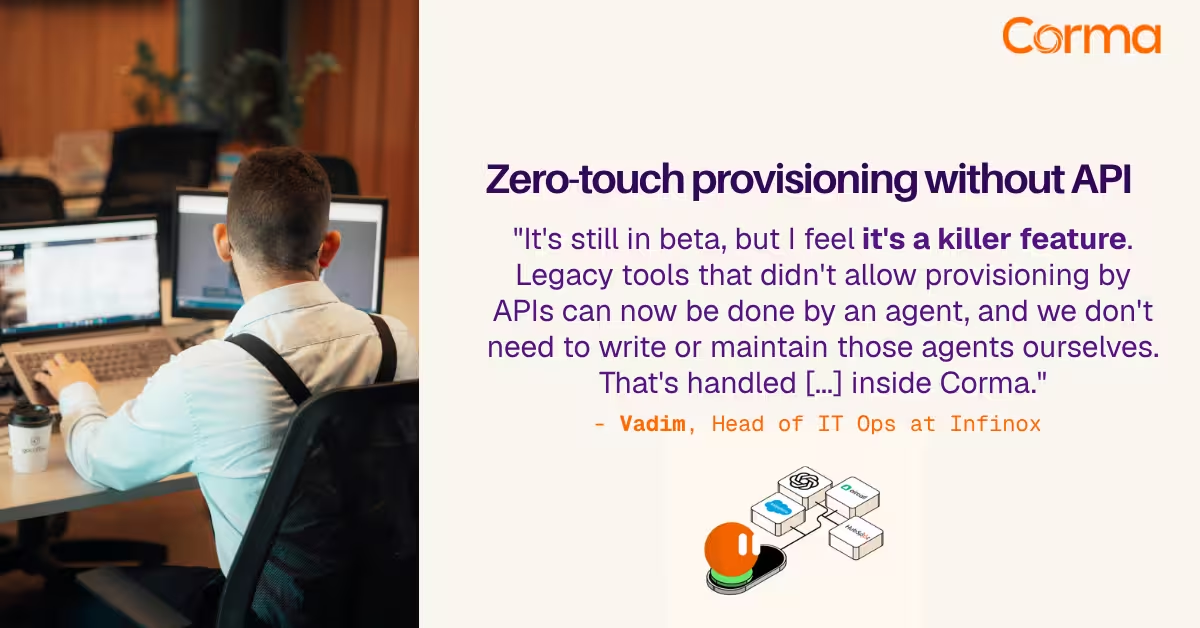
Corma’s custom agents in action at Infinox
The new standard in license management
Ready to revolutionize your IT governance?