Best Identity Governance and Administration (IGA) Solutions for Mid-Market Companies (2026)


Table of contents
- What is identity governance and administration (IGA)?
- IGA vs IAM: what is the difference?
- Core capabilities of an IGA solution
- How to choose an IGA solution for a company of 50 to 500 employees
- Best IGA solutions for mid-market companies in 2026
- Why Corma is the European IGA option for the mid-market
- Frequently asked questions
Identity is now the most common way attackers get in. According to IBM's Cost of a Data Breach research, compromised credentials rank among the most frequent initial attack vectors, and the cost of a breach climbs sharply when access is poorly governed. For a growing company, the risk is rarely a sophisticated zero-day. It is an offboarded employee who still has access to a finance app, or a contractor account nobody remembers creating.
This is the problem identity governance and administration (IGA) is built to solve. The challenge for a mid-market company is that most IGA tools were designed for large enterprises with dedicated identity teams, long deployment cycles and enterprise budgets. A 200-person company does not need a six-month SailPoint rollout. It needs governance that works in weeks.
This guide compares the best IGA solutions for mid-market companies in 2026, explains the selection criteria that actually matter at 50 to 500 employees, and shows where a converged, European option fits against the established US vendors.
What is identity governance and administration (IGA)?
Identity governance and administration (IGA) is the set of policies and software that manages digital identities and access rights across an organization, so the right people have the right access for the right reasons, and you can prove it. It combines identity lifecycle automation with access governance to reduce risk, prevent privilege creep and satisfy compliance audits.
An IGA solution rests on two pillars:
- Identity governance decides who should have access. It covers visibility, policies, role management, segregation of duties and access certifications.
- Identity administration handles execution: provisioning and deprovisioning accounts, managing credentials and assigning entitlements across cloud and on-premises systems.
In practice, IGA is the layer that answers the question auditors and security teams care about most: not just can a user log in, but should they still have that access, and where is the evidence?
IGA vs IAM: what is the difference?
IAM enforces access in real time. IGA governs that access over time. Identity and access management (IAM) handles authentication and the moment of access through single sign-on (SSO), multi-factor authentication (MFA) and federation. IGA sits on top: it defines the policies, runs the periodic access reviews and produces the audit trail that tells the IAM system what each user is actually allowed to reach.
Put simply, IAM is the lock on the door. IGA is the policy that decides who gets a key, checks every quarter that the right people still hold one, and keeps the logbook for the auditor.
If you want the deeper distinction between governance and management, our explainer on identity governance versus identity management breaks it down further.
Most IGA platforms converge on the same core feature set. When you evaluate IGA tools, these are the capabilities to confirm are present and, just as important, usable by a small team.
The capability that separates a real IGA solution from a basic IAM setup is access certification. Native directory tools can create and disable accounts, but they cannot run a defensible quarterly review campaign or produce the evidence an ISO 27001 or SOC 2 auditor expects. Corma's approach to automated and compliant access reviews is built precisely around that gap, and our user access reviews roadmap for ISO 27001 compliance shows how the process maps to certification requirements.
How to choose an IGA solution for a company of 50 to 500 employees
The IGA market is dominated by tools built for enterprises of thousands of users. That scale shapes their pricing, their deployment time and their complexity. A mid-market buyer should weigh different criteria.
What should a mid-market company look for in an IGA tool?
A mid-market company should prioritise time-to-value, SaaS coverage and compliance fit over enterprise breadth. The criteria that matter most are:
- Time to value. Look for a deployment measured in weeks, not quarters. A platform that needs a dedicated identity team to configure is a poor fit below 500 employees.
- SaaS-first coverage. Most mid-market access risk now lives in SaaS applications, not in on-premises Active Directory. Your IGA tool must discover and govern SaaS access, not just AD groups.
- Native IDP connectors. Integration with Google Workspace, Microsoft Entra ID, Okta and JumpCloud out of the box, so governance reflects your real identity provider.
- Compliance alignment. Built-in support for the access-control evidence required by ISO 27001, SOC 2 and the NIS2 directive.
- Data residency. Where your identity data is hosted matters for European companies. EU hosting and GDPR-native handling remove a recurring procurement and legal hurdle.
- Transparent, scalable pricing. Pricing that fits a growing company, without the enterprise minimums that price out smaller teams.
Why do most IGA tools struggle in the mid-market?
Most enterprise IGA tools struggle in the mid-market because they assume resources a 200-person company does not have. SailPoint and Saviynt are powerful, but they are engineered for large, complex environments and typically require specialist configuration and long implementation projects. The result is governance that arrives too late and costs too much for the problem at hand. For many mid-market teams, the realistic choice is a platform built for their scale from the start, the same logic behind our list of top IAM solutions for mid-size companies.
Best IGA solutions for mid-market companies in 2026
The list below covers the IGA solutions most frequently shortlisted in 2026, with the realistic best fit for each. The comparison table summarises how they line up on the criteria that matter to a mid-market buyer.
SailPoint
The recognised market leader in enterprise IGA, with deep lifecycle management, AI-driven governance and broad integration coverage. Best for large organisations with complex hybrid estates and a dedicated identity team. For most mid-market companies, its breadth and deployment effort exceed the need.
Saviynt
A cloud-native platform strong in highly regulated industries, with deep application access governance and segregation of duties. Best for enterprises with strict compliance mandates. Powerful, but broad for a typical 50 to 500 employee team.
One Identity
A governance and privileged access suite, particularly popular in SAP-centric and hybrid Active Directory environments. Best for larger IT teams that can operate a full suite. Suite complexity is the trade-off.
Okta Identity Governance
A governance layer that extends the Okta identity suite with access requests and certifications. Best for companies already standardised on Okta. Less compelling if Okta is not already your identity provider.
Lumos
A newer entrant focused on app access governance and self-service access requests, blending identity governance with application management. Best for mid-market to enterprise teams prioritising self-service. See our Corma versus Lumos comparison for a side-by-side view.
Torii
A SaaS Management platform with IGA capabilities that also reclaims unused licenses, fighting identity, app and financial sprawl in one place. Best for SaaS-first teams that want governance and license control together. It validates the converged model, though it is US-based. Our Corma versus Torii comparison covers the differences.
Corma
The European option that converges SaaS Management and IAM/IGA in a single platform, purpose-built for companies of 50 to 500 employees. Best for European mid-market IT and security teams that want governed access, SaaS visibility and audit-ready compliance without an enterprise rollout. Corma is EU-hosted, GDPR-native and ISO 27001:2022 certified.
Why Corma is the European IGA option for the mid-market
Most IGA solutions ask a mid-market company to choose: govern identities with an enterprise IGA tool, or control SaaS sprawl with a separate SaaS Management platform, and stitch the two together. Corma converges both into one platform, which is exactly where mid-market access risk lives.
Here is what that means in practice:
- Converged SaaS Management and IGA. Corma discovers your SaaS estate, governs who has access to what, and automates the joiner, mover and leaver lifecycle across applications, not just your directory. It also gives you full SaaS visibility to prevent shadow IT.
- European by design. Data is hosted in the EU and handled GDPR-natively, and the platform is ISO 27001:2022 certified and NIS2-ready. For European buyers, that removes a procurement and legal hurdle that US vendors often cannot.
- Built for mid-market speed. Onboarding is typically completed in under a month, not a multi-quarter project, with native connectors to Google Workspace, Microsoft Entra ID, Okta and JumpCloud.
- Audit-ready governance. Automated access reviews and certifications produce the evidence ISO 27001, SOC 2 and NIS2 auditors expect.
- Recognised by analysts. Corma was recognised in the 2025 Gartner Magic Quadrant for SaaS Management Platforms.
This is not theory. Satelia runs IGA in a healthcare setting on Corma, where access governance is a regulatory requirement, and Apgar uses Corma for automated IAM. Both are mid-market companies that needed governed, compliant access without an enterprise programme.
If you are evaluating IGA tools for a European mid-market company, the fastest way to see the difference is to explore the Corma identity governance platform or request a demo.
Frequently asked questions
What is the difference between IGA and IAM?
IAM enforces access in real time through SSO, MFA and federation, while IGA governs that access over time through access reviews, certifications, role management and audit trails. IGA defines the policies that IAM executes, which is why IGA is often described as sitting on top of IAM.
What does an IGA solution do?
An IGA solution automates the identity lifecycle (joiner, mover, leaver), runs periodic access reviews and certifications, enforces separation of duties, manages roles and entitlements, and produces audit-ready reports. The goal is to ensure users have only the access they need and to prove it to auditors.
What are the best IGA tools in 2026?
The most frequently shortlisted IGA tools in 2026 include SailPoint, Saviynt, One Identity and Okta Identity Governance at the enterprise end, and Lumos, Torii and Corma for SaaS-first and mid-market teams. The right choice depends on company size, SaaS footprint and compliance requirements rather than on a single ranking.
What is the best IGA solution for a mid-sized company?
The best IGA solution for a mid-sized company is one that deploys in weeks, governs SaaS access rather than just directory groups, and fits a team without dedicated identity specialists. Corma is built for this profile, converging SaaS Management and IGA for companies of 50 to 500 employees, with EU hosting and ISO 27001:2022 certification.
How much does an IGA solution cost?
IGA pricing varies widely. Enterprise platforms often carry high minimums and require paid implementation services, which is why they can be hard to justify below 500 employees. Mid-market platforms typically offer more transparent, scalable pricing. You can review Corma's pricing directly.
Does an IGA tool help with ISO 27001 and NIS2 compliance?
Yes. Access reviews, certifications, separation of duties and audit trails are exactly the access-control evidence required by ISO 27001, SOC 2 and the NIS2 directive. An IGA solution turns that evidence into a repeatable, exportable process instead of a manual spreadsheet exercise.
Is IGA only for large enterprises?
No. While the best-known IGA vendors target large enterprises, the underlying need (governed, auditable access) applies to any company handling sensitive data or pursuing certification. Mid-market platforms now deliver IGA at a scale and price that fit companies of 50 to 500 employees.
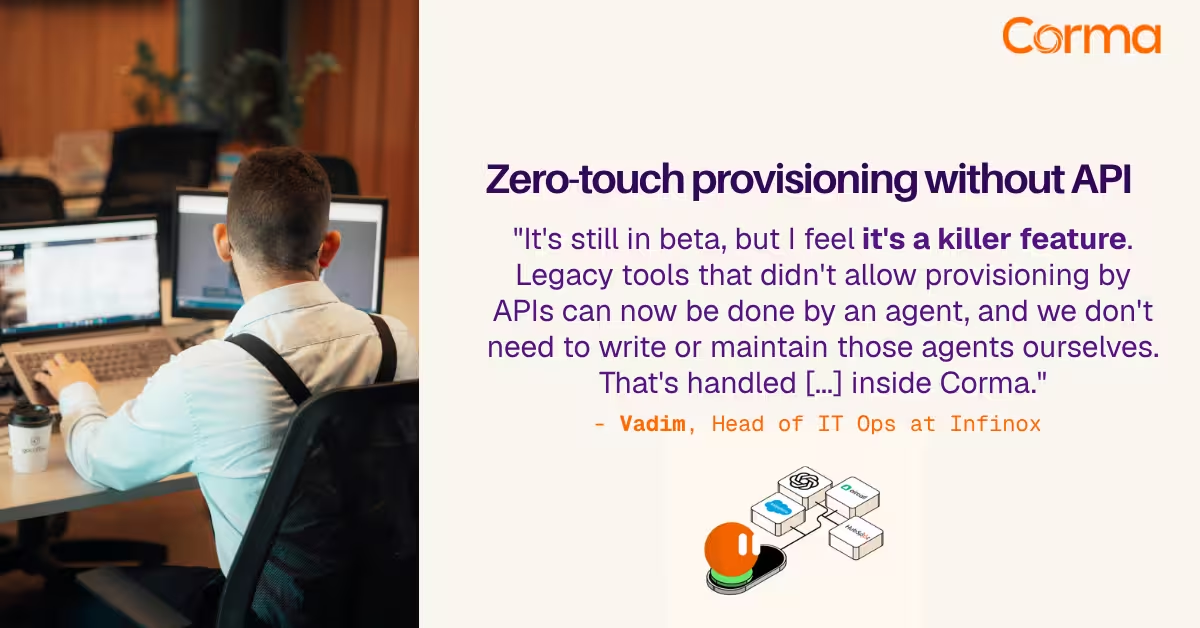
Corma’s custom agents in action at Infinox

Corma vs Torii: a practical alternative comparison for IT teams
SaaS Security Posture Management (SSPM): the mid-market guide
The new standard in license management
Ready to revolutionize your IT governance?