

This guide is for IT managers and IT operations leads at companies of 50 to 500 people who already run joiners, movers and leavers through tickets and checklists, and now need the process to hold across every SaaS app.
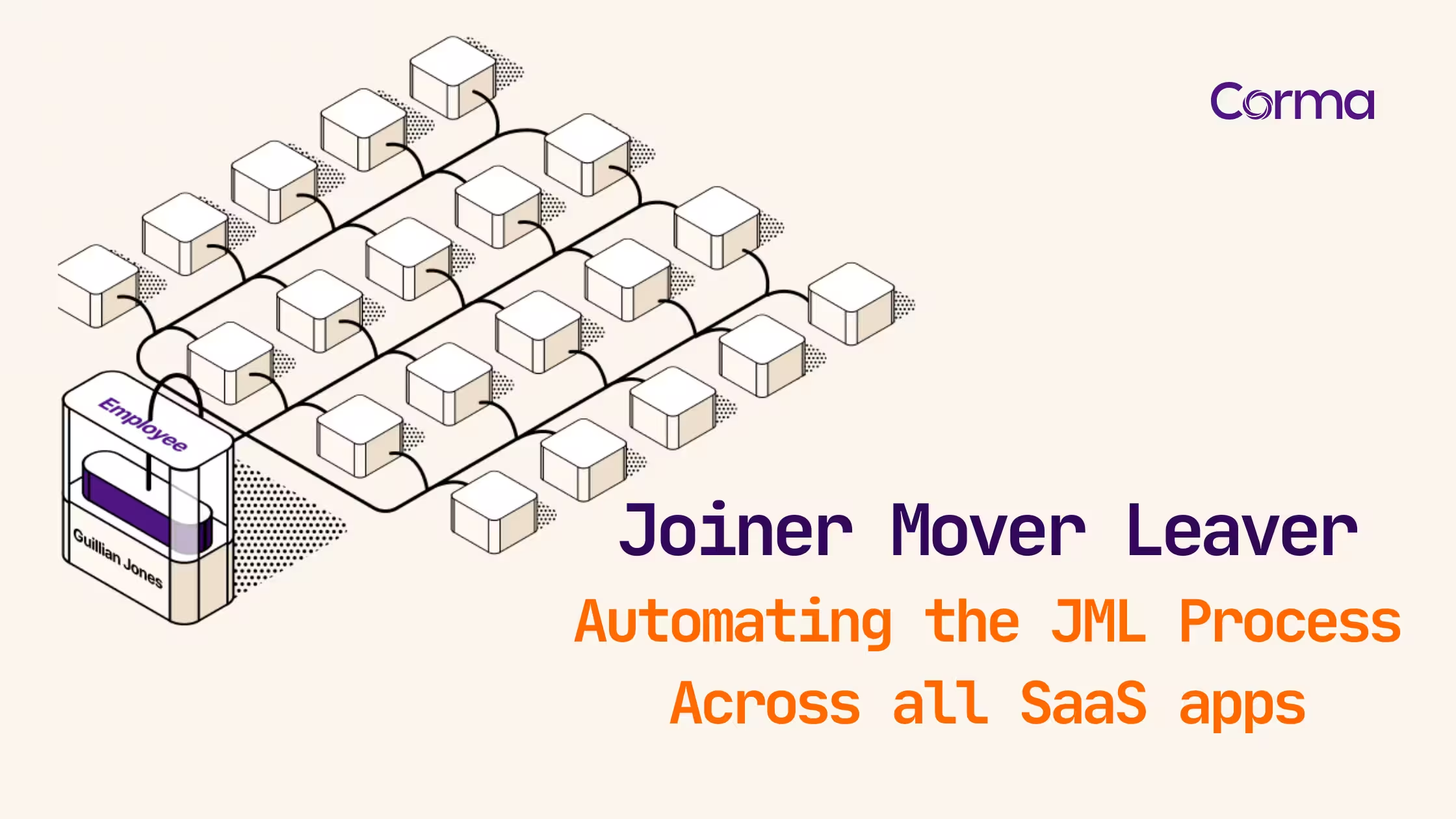
The joiner mover leaver (JML) process is the identity lifecycle framework that grants access when a person joins, adjusts it when they change role and removes it when they leave. Automating it means HR events trigger provisioning and deprovisioning in every SaaS application, not only in the identity provider. Coverage comes in tiers (SCIM, API connectors, browser agents), and any app left outside them needs a named owner and a dated manual task. The mover step, where access is added but rarely removed, is the one most JML processes miss.
If you only need a short definition, the JML glossary entry covers it in one paragraph.
Key takeaways
- SCIM provisioning is plan-dependent: Slack, for example, offers it on its Business+ and Enterprise plans, so JML coverage depends on connectors beyond SCIM.
- At Infinox, offboarding an average user fell from two to four hours across departments to about half an hour after automating it with Corma (Head of IT Operations, September 2026).
- Regulation (EU) 2024/2690 requires covered entities to modify access rights upon termination or change of employment, which puts movers in scope alongside leavers.
- Regulation (EU) 2024/2690 also requires access rights to be reviewed at planned intervals, so automating JML does not remove the need for access reviews.
What is the joiner mover leaver process?
The joiner mover leaver process is the set of rules and workflows that create, change and remove a person's access at the three moments their relationship with the company changes: arrival, internal move and departure. It is the operational core of identity lifecycle management, and its trigger should be the HR system, not an IT ticket.
- Joiner: an employee, intern or contractor gets an identity and birthright access (the apps every person in that role receives) before day one, with multi-factor authentication from the first login.
- Mover: a promotion, transfer, manager change or contractor-to-employee conversion. The new role's access is granted and the previous role's access is removed.
- Leaver: the identity is disabled, sessions and tokens are revoked, app accounts are removed, data ownership is transferred and licences are reclaimed.
Contractors follow the same three events with one extra rule: their access needs an end date from the start. The EU implementing regulation that details NIS2 measures for cloud, managed service and other digital service providers asks for third-party access to be limited "in scope and in duration".
JML events and the EU clauses that cover them
| Event | HR trigger | What must change | Typical failure | Regulation (EU) 2024/2690, Annex |
|---|---|---|---|---|
| Joiner | Start date in the HRIS | Identity created, role bundle provisioned, MFA enforced | Access copied from a colleague, exceptions included | 11.2.2(a): need-to-know, least privilege, separation of duties. 11.5.2(a): unique identities |
| Mover | New title, team, manager or location | New access granted, previous role's access removed | Old access kept "just in case" | 11.2.2(b): access modified upon change of employment. 11.2.3: modified based on organisational changes |
| Leaver | Termination date in the HRIS | IdP account disabled, tokens revoked, app accounts removed, licences reclaimed | Apps outside SSO left active | 11.2.2(b): access modified upon termination. 11.5.4: unneeded identities deactivated without delay |
| Contractor or third party | Contract start and end dates | Access scoped and time-bound | No end date set at creation | 11.2.2(d): third-party access limited in scope and in duration |
| Every event | Any change | Recorded in a register of access rights | Evidence rebuilt by hand before an audit | 11.2.2(e): register of access rights. 11.2.2(f): logging |
Method: clauses summarised from Commission Implementing Regulation (EU) 2024/2690 of 17 October 2024, Annex, points 11.2 and 11.5, read on EUR-Lex in October 2026. The regulation applies to the entity types listed in its Article 1; for other companies it is a precise reference, not a direct obligation.
Why does JML break once your stack is mostly SaaS?
Because an identity provider only governs the apps connected to it. Apps outside single sign-on, seats bought on a company card and admin accounts created locally sit outside the JML flow, so a fully automated leaver step can still leave access open.
Vadim, Head of IT Operations at Infinox, a CFD brokerage that grew close to threefold in a year through expansion and acquisition, described the manual version in an interview published by Corma in September 2026:
"We had to manually revoke all their access, track down every service desk to see what had been given and what hadn't, and then over time we'd keep discovering access that was still remaining."
Senior and long-tenured leavers, he added, "tended to have a lot of shadow access". Three patterns explain most of these gaps:
- A late or missing trigger. The risk Vadim described was access missed "during a late-night or last-minute offboarding, when HR forgot to flag it".
- Apps outside SSO and SCIM. The identity provider disables the account it knows; the app with a local login keeps working.
- Clustered events. At Infinox, "clusters of 11 or 15 onboardings on a Monday" required "a lot of the team's attention", and six offboardings on a Friday used to be "a full team effort".
What happens when HR does not tell IT?
The leaver step starts late, and every hour of delay is an open account. The fix is structural: the termination date in the HRIS becomes the trigger, pushed by integration or webhook rather than by email. Infinox runs it that way for its integrated brands: "HR sets a termination date, or when the person leaves, we get notified automatically through a webhook." For brands not yet integrated, the team still enters the date by hand from an email.
A second net catches what the trigger misses. Infinox sends automated monthly reports on inactive users to managers and HR, so an account that outlived its owner surfaces within a month instead of at the next audit.
How do you automate joiners, movers and leavers?
Start from the HR record, turn roles into access bundles, give every app a connection tier and an owner, then let all three events run through one workflow engine with logging on by default:
- Make the HRIS the only trigger. Start date, change of title, team or manager, and termination date are the events. Corma reads these attributes from HR tools such as HiBob, and its IT workflow builder fires start-date and end-date triggers at midnight company time by default, or at a set hour such as 18:00 on someone's last day.
- Turn roles into bundles. For each role or team, list the apps and licence types needed on day one. A bundle replaces the "copy what their colleague has" habit, which imports the colleague's exceptions.
- Give every app a connection tier and an access owner. SCIM, API connector, browser agent or manual task, plus the person notified when a manual step is due.
- Write the mover rule as remove and add. Compare the old bundle with the new one, remove what the new role does not need, and allow any handover overlap only with an end date.
- Sequence the leaver. Disable the identity provider account and sessions first, then revoke tokens, deprovision each app, transfer document ownership and reclaim licences in your SaaS management platform.
- Log everything and fail loudly. Every grant and removal goes into a register of access rights, and a failed run stays visible until someone fixes it. Corma's provisioning module parks failed runs in a "Needs attention" status until they are retried or skipped.
For day-by-day checklists, including pre-boarding and document handover, see our complete guide to automating IT onboarding and offboarding. The rest of this page covers the two places where JML usually leaks: movers and apps without SCIM.
Why is the mover step the one JML processes miss?
Because a move adds access visibly and removes it invisibly. The new manager asks for the new tools; nobody asks for the old ones to be taken back. Permissions accumulate with each promotion, transfer and reorganisation, a drift known as privilege creep.
EU rules treat the mover as seriously as the leaver. Point 11.2.2(b) of the NIS2 implementing regulation asks covered entities to "ensure that access rights are modified accordingly upon termination or change of employment". A change of employment sits in the same sentence as a departure.
Our reading of the Infinox interview points the same way: senior leavers carrying "a lot of shadow access" were, years earlier, movers whose old rights were never removed. A mover workflow that holds has five parts:
- Diff, then remove what the new role's bundle does not justify, on the effective date.
- Time-box the overlap: if a handover needs both sets of access, the old access gets an expiry date when the overlap is granted.
- Route extras through access requests, so anything outside the new bundle carries an approver and a date instead of becoming a silent exception.
- Review the sensitive apps (finance, HR, admin) for the moved person a few weeks after the move.
- Count manager changes as mover events, because they change who approves access.
How do you detect a role change if HR does not notify IT?
Compare HR attributes with directory groups on a schedule. When the title, team or manager in the HRIS no longer matches the person's identity provider groups, flag the gap and open a review. Corma syncs user groups from Google and Microsoft identity providers and can use those groups to trigger onboarding workflows, which keeps group-based access tied to the directory rather than to tickets. The removal side still needs the diff above.
Residual access from old roles is one of the four buckets covered in our guide to deprovisioning and orphaned accounts, which deals with access accumulated before automation starts.
How do you automate JML in apps without SCIM?
Treat SCIM as one connection tier among four: SCIM where the vendor's plan includes it, an API connector where the vendor exposes an admin API, a browser agent that repeats admin-console steps where neither exists, and a dated manual task for the rest. Every app in the inventory gets a tier and an owner, so no leaver step ends silently at the identity provider.
SCIM is often plan-gated. Slack's help center, checked in October 2026, lists SCIM provisioning on its Business+ and Enterprise plans, so the same app can sit in different tiers depending on your subscription.
JML coverage by connection tier
| Tier | How it acts | JML events covered | What to plan for | Evidence produced |
|---|---|---|---|---|
| SCIM | Create, update and deactivate calls pushed through a standard protocol | Joiner, mover (group and role attributes), leaver | Depends on the vendor plan; some apps support deactivation but not role changes | Provisioning logs in the IdP or the platform |
| API connector | The platform calls the vendor's admin API | Provisioning, deprovisioning, licence and role data | Coverage depends on the endpoints the vendor exposes | Connector run history |
| Browser agent | An agent repeats admin-console steps recorded once by an administrator | Provisioning, deprovisioning, licence extraction for apps with no usable API | Needs an admin account and test accounts; a dedicated service account may use a paid seat | Video replay and step-by-step log for each run |
| Manual task | A dated task goes to a named access owner | Whatever no other tier reaches | Keep the list short and owned; due date before the last day | Ticket with timestamp and owner |
Method: tiers defined by Corma's editorial team from Corma's product documentation (Provisioning, Workflow Builder and Custom Agent pages) and vendor plan pages, read in October 2026. An app's tier depends on the vendor and on your plan with that vendor.
In Corma, the browser agent tier relies on custom agents: an agent learns an app's provisioning or deprovisioning steps by watching an administrator perform them once in a secure browser, then passes a live validation run. Corma's documentation states that the agents run on its infrastructure on AWS in the Paris region and never see or store the administrator's password.
Vadim at Infinox describes the effect: "Legacy tools that don't allow provisioning through an API can now be handled by an agent instead, and we don't need to write or maintain those agents ourselves." Where a legacy app cannot be fully offboarded because it requires full admin rights, the agent still enforces a minimum: "at minimum we can remove all their permissions, reset the password, and flag the account as a leaver."
For the manual tier, timing is the control. Since July 2026, a Corma workflow action can open a Jira ticket seven days before an employee's last day, listing the accounts that need manual removal. Our dedicated guide covers offboarding apps that don't support SCIM, SAML or SSO.
To see these tiers in one flow, the page on automated provisioning and onboarding shows the joiner side end to end.
What does NIS2 require from a JML process?
The NIS2 Directive (EU) 2022/2555 lists "human resources security, access control policies and asset management" among the measures essential and important entities must take (Article 21(2)(i)). For specific digital service providers, Implementing Regulation (EU) 2024/2690 turns that line into JML-level duties: modify access on termination or change of employment, keep a register of access rights, log their management, review them at planned intervals and deactivate unneeded identities without delay.
Article 1 of the regulation limits it to DNS service providers, TLD name registries, cloud computing, data centre and content delivery network providers, managed and managed security service providers, online marketplaces, search engines, social networking platforms and trust service providers. Other companies in NIS2 scope apply Article 21 through national law, and point 11 of the regulation's Annex remains a precise, public checklist of what a JML process should evidence.
Does JML automation replace access reviews?
No. Vendor content is split: some presents lifecycle automation as a substitute for certification campaigns, other guides keep quarterly reviews. The regulation settles it for covered entities: "The relevant entities shall review access rights at planned intervals and shall modify them based on organisational changes." Point 11.2.3 also requires the results to be documented. Automation changes what a review finds (exceptions, manual tasks, overlaps past their date), not whether it happens.
At Brevo, El Houcine, interviewed on Corma's blog in April 2026, said external user access reviews "have helped us keep permissions up to date", on top of automated offboarding. A review that targets contractors and exceptions is short; one that re-certifies every birthright entitlement is the one teams dread. Automated access reviews in Corma run on a schedule and record reviewer decisions as evidence.
How fast must a leaver lose access?
Vendor guides disagree on timing, from immediate removal to removal on the last day or at an agreed time. Points 11.2 and 11.5 of the regulation set no number of hours: access rights are "modified accordingly upon termination" and unneeded identities are deactivated "without delay". In practice, you define the deadline per tier in your access control policy and keep the timestamps that prove you met it. For example:
- Identity provider account and sessions: disabled at the termination time.
- SCIM and API-connected apps: removed in the same run.
- Browser-agent apps: removed the same day.
- Manual-tier apps: task opened before the last day, closed within your policy deadline.
Infinox shows what that looks like for a Friday departure: "When HR flags that access needs to be revoked, we know the majority of it will already be revoked, so we just need to do the actual cleanup."
How do you measure a JML process?
With four numbers: time to access for joiners, time to deprovision for leavers per connection tier, the share of apps covered by each tier, and the manual tasks still open on the exit date. Tickets closed say little; these four say whether access matches the HR record.
- Time to access: from the start date to every bundle app being usable.
- Time to deprovision: from the termination time to the last app removed, split by tier.
- Tier coverage: apps in each tier as a share of the full inventory, including apps outside SSO.
- Open exceptions at exit: manual tasks not closed when the person leaves.
Field numbers give a sense of scale. At Infinox, offboarding went from "two to four hours across different departments and people" to "about half an hour for an average user, maybe up to an hour", with senior leavers still taking longer. Vadim believes onboarding and offboarding "used to be the majority of our service desk tickets and work time, based on our quarterly service desk analysis", and while the company grew roughly threefold, his IT operations team grew by less than double.
At Brevo, Corma automated over 70 onboardings and offboardings in the three months before the interview, published in April 2026, and the Brevo customer story reports over 400 automated onboardings and offboardings for around 1,000 employees.
Do you need an IGA suite to automate JML?
Not necessarily. What decides is how many of your apps each option reaches. Identity provider lifecycle features cover the apps federated with that provider; enterprise IGA suites add deep governance for large, often hybrid estates; a SaaS management and IAM platform targets the long tail of SaaS apps a 50 to 500 person company runs, including those outside SSO.
Licence tiers matter too. Microsoft's documentation, checked in October 2026, states that Microsoft Entra Lifecycle Workflows, its joiner, mover and leaver feature, require Microsoft Entra ID Governance or Microsoft Entra Suite licences.
Which JML automation option fits which situation
| Situation | Option that usually fits | Check before choosing |
|---|---|---|
| Most apps federated with one identity provider, few roles | Identity provider lifecycle features | Licence tier required for lifecycle workflows; what happens to apps outside SSO |
| Thousands of identities, on-premises systems, a dedicated IAM team | Enterprise IGA suite | Implementation effort; connector coverage for SaaS apps |
| 50 to 500 people, dozens to hundreds of SaaS apps, many outside SSO, licence spend under scrutiny | SaaS management and IAM platform | Connection tiers available for your long tail; HRIS and identity provider connectors |
Method: editorial guidance built on the coverage logic of this article. It is not a ranking of vendors.
For governance depth, see Corma's identity governance and administration platform.
How does Corma automate JML across your SaaS stack?
Corma is a European platform that combines SaaS management with identity and access management, so it sees the apps your identity provider does not and acts on them. Applied to the joiner mover leaver process:
- HR-driven triggers from HRIS integrations such as HiBob, Personio, Lucca and Deel, with start and end dates driving onboarding and offboarding.
- Native connectors to Google Workspace, Microsoft Entra ID, Okta and JumpCloud: Corma governs on top of your identity provider instead of replacing it.
- Four connection tiers, from SCIM and API connectors to custom browser agents and dated manual tasks routed to access owners.
- Joiner, mover and leaver workflows started from the HRIS, the identity provider, your apps or the API, with actions such as revoking all tokens or launching an access review.
- Licence reclaim at the leaver step, since seats and spend live in the same platform.
- EU hosting and ISO/IEC 27001:2022 certification.
Corma was included in the 2026 Gartner Magic Quadrant for SaaS Management Platforms, its second consecutive appearance, as reported by IT Brief UK in June 2026. In the same article, CEO and co-founder Héloïse Rozès explained why periodic clean-ups no longer hold:
"There was a time when IT teams could clean up the SaaS stack relatively easily and periodically on their own, but that world is gone."
HR teams can follow the same workflows from their side with Corma for HR teams.
Want to see joiner, mover and leaver workflows on a stack like yours? Request a Corma demo with your HRIS, identity provider and the apps your offboarding checklist still covers by hand.
Frequently asked questions about joiner mover leaver
What does JML stand for?
JML stands for joiner, mover, leaver: the three events at which a person's access must be created, changed or removed. Some UK organisations call the same process starters, movers and leavers.
What is the difference between JML and onboarding and offboarding?
Onboarding and offboarding are the people processes around arrival and departure, from equipment to training. JML is the access view of the employee lifecycle, and it adds the mover event that onboarding and offboarding checklists usually skip.
Is SCIM required to automate JML?
No. SCIM is the cleanest connection where the vendor and your plan support it, but API connectors, browser agents and dated manual tasks cover the apps SCIM does not reach. What matters is that every app has a tier and an owner.
What are Microsoft Entra lifecycle workflows?
Lifecycle Workflows are Microsoft Entra's built-in joiner, mover and leaver feature. They automate tasks on Entra ID accounts such as group and Teams membership, licence assignments, account status and refresh tokens, and Microsoft states they require Entra ID Governance or Entra Suite licences.
Does a company of 50 to 500 people need an automated JML process?
Usually yes, once offboarding means checking more apps than one person can remember. A growing team with dozens of SaaS apps reaches that point well before 500 people, especially when hires or departures arrive in clusters.
What is identity lifecycle management?
Identity lifecycle management is the discipline of creating, updating and removing digital identities and their access from the first day to the last. JML is its operational core, and access reviews are its control loop.
What should a JML policy contain?
A JML policy names the HR events that trigger access changes, the systems that act on them, who approves exceptions, the deadline for each leaver tier, how contractor end dates are set and how often access is reviewed.